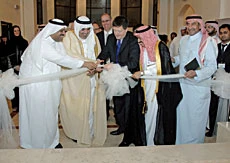
JEDDAH: Deputy Mayor of Jeddah Khaled Akheel officially opened a major touring exhibition of photographs by eight UK and Middle Eastern photographers at the Bait Al-Bont Museum in Jeddah on Thursday evening. With the title “My Father’s House,” the exhibition arrived in the Kingdom as the third stop in its yearlong tour of five countries in the Middle East: Oman, Bahrain, the UAE, Saudi Arabia and Qatar. Plans are under way for “My Father’s House” to be shown in the UK following its tour of the Middle East.
“The exhibition looks at cultural heritage, but we have built a series of activities and workshops with the aim of encouraging everyday people to think about what heritage means to them and how they might make their own record,” Sean Williams, curator and mastermind behind the exhibition, told an audience of invited guests at the opening ceremony. “One of the main aims of the exhibition is to show people how the photographers have used the medium to present ideas.”
In the exhibition, five emerging Middle East artists and three UK photographers (including the winner of the World Press Photo of the Year 2007, Tim Hetherington) use large-scale photography, audio-visual media and film to examine how the built environment reflects the people, the community, society and the nations of the Middle East.
The exhibition will be the centerpiece of the “My Father’s House” project that also includes related activities for the general public: an online photography competition and photographic treasure hunt for families, workshops for emerging and professional photographers, talks by the photographers, seminars and conferences on architecture and heritage, educational packs and events for schools and colleges.
Williams, outlining the raison d’etre for the exhibition, said he had asked for a series of submissions from photographers in the Gulf and the UK from artists working with film or photography to present their particular takes on the idea of cultural heritage and what it means to them, their compatriots and the local community.
“As a result we have three artists from the UK and five from the Arabian Peninsula, each of whom has his or her own take on the subject,” said Williams. “The most traditional as we would regard it is by Tim Loveless who took the icons of national importance: the fortifications that have been restored as emblems of national pride in Oman and the Emirates.”
He noted that the works touched on the academic debate about how and why we chose to preserve certain buildings as opposed to others.
“Some of the images are of restored buildings, but alongside there are buildings from the fifties that use modern building materials but follow the local vernacular style,” he said.
Williams said one of the most interesting proposals was from Saudi artist Wed Abdul-Jawad. What links her exhibition was the theme of architecture. Abdul-Jawad uses a pinhole camera to make portraits of the old city of Jeddah and running with the display is a selection of interviews with some of the residents of the old quarter.
“Wed points to the other traditions linked with heritage — music, storytelling — and addresses the question of ‘how do we preserve those things?’” said Williams. “When we move on culturally and leave old buildings behind, we don’t just leave them, but also the communities and traditions that grew up with them.”
Yemeni photographer Boushra Almutawakel said that in her society it is difficult to take portraits of people for many reasons. She nevertheless mounted an introduction to contemporary society both in the old and new city of Sanaa by focusing on the interiors of people’s homes. From those rooms we are given clues to how people live and their values.
One photographer — Hazel Thompson — said that when she produced her proposal she had no idea what role women played in the Middle East and admitted to preconceived ideas about it. It was a journey of discovery for her as well as a recording of a slice of Middle Eastern life. She proposed a project that would explore how women contributed to all aspects of cultural life.
She submitted individual portraits of 10 women ranging from young university students to grandmothers, “showing how active they are in so many fields, not only in the socially conventional social fields but also in business and the arts.”
The exhibition is in the Bait Al-Bont museum (facing the south side of the Al-Mahmal Shopping Center and Mosque in Balad) and later moves to the National Museum in Riyadh where it ends on Nov. 25.