
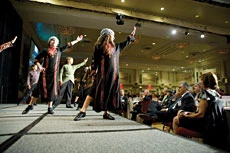
Dance well and if you dance well — you will have a beautiful surprise.” This is what a school principal, Mrs. Selwa Zananiri, told eight students at Rawdat El Zuhur School in East Jerusalem. The students were practicing the Dabkeh, the Palestinian national dance, for this year’s final competition against 14 other Jerusalem schools. Neither Mrs Zananiri nor the children had any idea that when the youngsters won — which they did for best performance last April — that she would be able to offer them more than the token gifts she bought them.
“We received a call from ANERA (American Near East Refugee Aid) and they invited the children to dance at their annual dinner — in Washington, D.C.” Mrs. Zananiri said.
ANERA, a US nonprofit organization that provides assistance to Palestinian communities and low-income families throughout the Middle East and supports their co-educational secular school, brought the children — four girls and four boys — out of Jerusalem for the first time in their lives — to perform their dinner in Washington last week.
It was not an easy trip. Traveling from East Jerusalem to Washington took more than a day, including a five-hour security check at Ben Gurion airport. “After we got through the checkpoint, the children asked me if we had arrived,” said Mrs. Zananiri. “I told them, ‘Almost,’ — they had no idea that they had another 17 hours to go before they were in Washington.”
Once they arrived, the children, ages 9 to 11, voted on places they wanted to visit during their week-long stay in the US capital. Besides the Capitol and the White House, they took a bus tour of the city, saw the Air and Space Museum, the Museum of Natural History and most of the animals at the National Zoo. “They wanted to see the pandas and the gorillas,” said Mrs. Zananiri.
Another surprise came when the children saw the White House. They photographed themselves on the street, standing in front of the White House, but they had no idea that a special tour had been arranged for them. “They wanted to see the White House, and they were astonished when they learned they could go inside,” said Mrs. Zananiri.
Another surprise came when they were greeted by Bo, the Obama’s family dog. At first they didn’t understand who Bo was — they thought it was just a dog — until the tour guide explained to them that this was the president’s dog and the most famous dog in the world. “Once they understood, they were thrilled,” said Laurie Kassmann, ANERA’s Media Relations officer who accompanied the children, adding: “The tour director later told me they were the best behaved children that he had ever taken on a White House tour.”
One ANERA donor gave each of the children $60.00 to go shopping. “The children surprised us because they bought gifts for their family members, but not things for themselves,” said Kassmann. “They bought shirts, blouses, necklaces, earrings, and watches,” said Mrs. Zananiri. “They all wanted special gifts for their mothers.”
At ANERA’s annual dinner, the children’s performance brought the house down. Over 400 people attended the gala, whose theme was: “Hand-in-Hand, Building Schools, and Transforming Lives.” Donations topped more than $260,000 to help ANERA build new schools in the West Bank, renovate pre-schools in Gaza, and equip vocational training centers in Lebanon.
“Countless people left the dinner saying that it was the first time in ages that an evening dedicated to the Middle East had not depressed them. They were inspired by children who had dreams and hopes for the future despite all the politics around them,” said Bill Corcoran, President of ANERA. “We hope that ANERA’s efforts will make their dreams come true.”
Corcoran added that another moving moment in the evening was when the ANERA Director from Gaza received a standing ovation. “It was an emotional moment that reminded everyone that Gaza had not been forgotten.”
In raising funds for education, the dinner honored three of ANERA’s outstanding, long-time partners in the Middle East: Al Kafaàt Foundation in Lebanon, Atfaluna Society for Deaf Children in Gaza and Rawdat El Zuhur in Jerusalem.
Despite the popularity of the young dancers, they will not return next year. “Every year we feature different projects; this year was for education which is why the children were invited. Last year we raised money for infrastructure in Palestine and we had two of our engineers from the ANERA staff in the West Bank speak to us at our annual dinner,” said Nancy Nye. The Director of Donor Stewardship was the former principal for the Friend’s Girls school in Ramallah, and lived ten years in Jerusalem and Ramallah.
In previous years, Nye said ANERA’s gala dinners honored those working in “health care and medical fields. We try to feature people who are on our staff, or beneficiaries of our projects in the Middle East.”
Nye said the children’s dance troupe was invited because in 1968, one of ANERA’s first projects was to distribute funds to schools, which included Rawdat El Zuhur School. “They are one of our oldest project partners; we’ve been working with them for almost 40 years. As for these children, their lives will never be the same; their experience here has transformed their lives. That’s was education is all about — a transformation,” said Nye. The visiting Palestinian children returned home last weekend. Before they left, Arab News asked them what they would like to say to American children.
Reem Khatib, who wants to become an engineer like her father, said: “We wish we could do the same for them as has been done for us. We wish we could help Americans to come to Jerusalem and visit us, so we could be as kind to them as people here in Washington have been kind to us.”
Qais Hujoj, clearly the groups biggest cut-up, said: “I would like to show a group of Americans our culture, our way of living and how to dance the Dabkeh.”
“Dear God, I wish I could get my parents here,” said Shams Aldin Badran, whose favorite subject in school is math. “The country looks safe; there is nothing disturbing here. I wish I could bring my family and my friends here.”
The size of the United States intrigued the children; they had nothing to compare it with but the West Bank as they’ve never be able to travel anywhere else.
“At first I thought the US was a small country, with not many people, because I compared it to Palestine,” said Rayaan Abbassi, who hopes to become a surgeon. “I didn’t know there were good people here, but my ideas changed when I came here.”
At their school, said Mrs. Zananiri, “We have a ‘character tree’ where every year we add a ‘value’ that we wish for all human beings. This year, we added ‘dream’ to the value tree. The children here said their dreams are to be able to go to high school, while others said they dreamed for peace all over the world.”