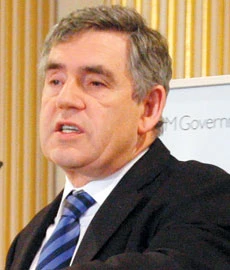
LONDON: The world faces “catastrophe” if action is not agreed at the UN climate summit in December, British Prime Minister Gordon Brown warned Monday as major polluting countries met in London.
Brown told representatives from 17 top polluters at the Major Economies Forum (MEF) that the costs of failing to address global warming would be greater than the impact of two world wars.
He said a deal at December’s conference in Copenhagen was possible, amid recent warnings from the United States that the meeting could fail in its goal to draw up a successor to the Kyoto Protocol. But with fewer than 50 days to go before the UN talks, Brown warned that countries were failing to make progress quickly enough to reach agreement.
“We can’t afford to fail. If we fail, we pay a heavy price,” he warned. “For the planet, there is no plan B.” Brown called on world leaders to work together directly to achieve a deal which sets out binding targets for rich countries to cut their emissions, and finance to help the poorest countries cope with the impact of climate change.
The prime minister said: “If we do not reach a deal at this time, let us be in no doubt: Once the damage from unchecked emissions growth is done, no retrospective global agreement in some future period can undo that choice. By then it will be irretrievably too late.
“So we should never allow ourselves to lose sight of the catastrophe we face if present warming trends continue.” Brown said he shared the concerns of low-lying island states such as the Maldives — whose government held an underwater Cabinet meeting Saturday to focus on rising sea levels that threaten to submerge it — were being hit hardest and first.
The MEF comprises Australia, Brazil, Canada, China, the European Union, France, Germany, India, Indonesia, Italy, Japan, South Korea, Mexico, Russia, South Africa, Britain and United States. Its members represent about 90 percent of global emissions.
The London talks are focusing on emissions cuts, the protection of forests and climate finance. Brown has said $100 billion a year is needed to help developing countries tackle climate change. Brown, however, said that “the signs of momentum, of forward movement, are now unmistakable.”
India is ready to set itself nonbinding targets for cutting carbon emissions, while China says it would curb the growth of its emissions by a “notable margin” by 2020, although it did not specify further. “What we need to have happen is for China and India and Brazil and South Africa and others to be willing to take what they’re doing, boost it up some, and then be willing to put it into an international agreement,” he said.