
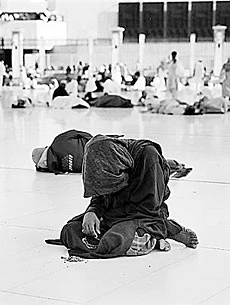
If we are a product of our societies then what does that say of Reem Al-Faisal — the granddaughter of the late King Faisal — who has achieved fame, not only for her photographic works but also due to her outspoken stance against injustice which, according to her, is the price Arabs have had to accept in order to be allowed to join the forces of Western global capitalism. Reem is a documentary urban photographer who mainly photographs in black and white and her works have been exhibited for more than a decade. She sees her photography as a mystical journey through God’s creation. She is based in Paris, Jeddah and Dubai and also writes for Arab News and other publications. A few months ago she opened an art gallery in Dubai, dedicated only to photography, called “The Empty Quarter”.
This statuesque woman is intelligent and articulate, and she tells it like it is without toeing any political line or agenda.
Muslims around the world are still reeling from the carnage that took place in Gaza. The inability of Middle Eastern governments to stop the killings may be explained by them “as a failure of diplomacy” in line with the Lebanese war in 2006 and of course the failure to resolve the Palestinian issue. However, these bloody events for people like Reem have meant a wake-up call for Muslims to stop looking to the West to sort out their problems and start to take charge of their own history.
In an article titled “What ails the Arab world,” she argues there is an obsession in the Arab world with “business,” where the focus is on “the rise in petrol prices,” “the economic boom” and “which economic model Arab societies should take.”
She explains: “The situation in Palestine has never been this bad. An entire nation has been put in concentration camps and left to starve and the Arab world finds that it doesn’t merit a crisis call. Iraq is occupied and brutalized and you don’t even call for resistance, preferring to denounce the chaos without accusing or holding to account those who are responsible for it. Somalia is virtually gone and you haven’t budged. Soon Iran will be bombed and then more chaos will engulf the entire region but you are enthusiastically talking about economic growth. It is as though you are building a house over an active volcano and worse, it is already rumbling and all you talk about is how you are going to decorate it.
“The fact that our grandfather was King Faisal meant we had a lot to live up to; he was a visionary, a trailblazer and, more importantly, a Muslim before he was an Arab.”
She is very scathing about the advent of the pan-Arab movements which led to nationalism and the alienation of Muslim from Muslim.
“Nationalism is the worst thing that happened to us, it led to regionalism and then to ethnicism, where do you draw the line? We have gained nothing by being Arabs. The pan Arab movements of the 20th century just alienated brother from brother; we don’t see other Muslims like Indonesians and Indians in the same way as we see ourselves. That is why we can disconnect from the sufferings of the Iraqis or the Palestinians.”
She added: “Hundreds of years ago, as Muslims, we had managed to achieve sophisticated economies, for example during the times of the Ottomans and the Moguls, it was perfectly natural to work in Kabul and study in Egypt. There was a synthesis and Islam was the thread that bound us together. As we turned away from our history, we became small and parochial.”
She argues that by trying to fix the ills of the Arab world with foreign medicine has bred such diseases as terrorism and violence. “We don’t even know our history; colonialism was the raping of our culture and way of life, and today we live under neo-colonialism. This happened not only to us but also to Africa and other nations around the world, but we as Muslims had an option; we had Islam and Muslim economies and culture; instead we abandoned our history and turned to the West to help us.”
She argues that there are many problems linked to the phenomena of puritanism, which many Western countries use as an example of our backwardness; however, as she explains, “puritanism is a natural kneejerk reaction to modernity. By modernity, we mean a Western style of life and culture that has been shoved down our throats.”
However, she is optimistic and believes that negative forces cannot harm the billions of Muslims around the world if “we can begin to appreciate what Islam has taught us and learn from our history and our civilizations, we can achieve success spiritually and materially.” As she moves with ease from one project to another and from one continent to another she believes that life is precious and we should try to do the best we can in the short time we are here.