
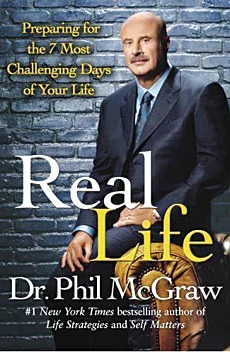
Most of us know Dr. Phil from his popular TV talk show. He is successful because he relates so well to his audience and he can also convey complex thoughts in simple words. Compassionate, always calm, never overpowering, this charismatic psychologist has mastered the art of nailing down a problem, understanding its root causes and offering an appropriate solution. His reassuring behavior and infectious desire to help people have won him enthusiastic fans all over the world.
Dr. Phil McGraw has written two bestsellers, “Life Strategies” and “Self Matters” and his latest book, “Real Life,” is also about self-help. Unlike most self-help books which deal with generalities, “Real Life” shows us how to mobilize our resources at the most challenging times of our lives. The author makes us go through some of the most common crises we are likely to experience -- the deaths of family members, illness, financial problems, divorce or severe stress in order to change the attitude with which we approach life:
“Imagine someone who is a black belt in martial arts walking down a dark alley late at night. Then imagine someone who doesn’t have that training going down that same alley. The difference in their experience of that walk is huge. Ultimately, my goal with this book is to equip you to walk with confidence and power, not based on a false bravado, but based on readiness,” says Dr. Phil.
Living with perspective helps us develop a healthy approach to daily problems. Nowadays, many people are so engrossed in making money, they spoil their marriages and hardly pay attention to their children. They are not even able to realize they possess the best in life because they define their wealth solely in terms of money.
We often become overtly upset because we lack perspective. Whenever we are faced with a problem, we need to place it in a larger framework and ask some questions: Is my family healthy and prosperous? Do I have a job? A nice house? Good friends? We soon conclude that the incident that has upset us is not a big deal at all in the grand scheme of things.
Furthermore, the best way to manage a crisis is to control the situation, stop blaming others or playing the victim and to take action. If you do nothing, you get nothing: Life rewards action. We definitely need to react to stress which affects so many of us. Stress is the reaction of the body and the mind to things which impact us mentally, emotionally and physically.
Stress should be taken seriously. It can affect the immune system, disrupt the digestive system and increase the incidence of obesity, hypertension, heart attacks, strokes, osteoporosis, ulcers, cancer, multiple sclerosis and lupus. Stress definitely takes years off our lives. To prove this point we have only to compare the photos of a president the day of his inauguration and the day he leaves office.
The pace of life has never been so fast and we are experiencing one of the most stressful times in the history of mankind. With our mobile phones and the internet, we are connected 24/7 which makes us feel anxious and impatient. We are led to believe this is normal when it is, in fact, detrimental to our mental and physical health as it severely influences the quality of our life.
The good news is that there are ways to deal with stress. It is well known that regular exercise, (20 to 30 minutes daily) releases endorphins, the so called ‘feel-good’, hormones, lowers blood pressure and clears the mind. But there are even easier things you can do, like laughing at least once a day. Research shows that people have cured themselves from serious diseases by watching hours of funny movies or television shows. Bring laughter into your life by seeing a comedy or try and spend more time with your kids. You can also take a warm shower: Saunas and thermal baths have been used for centuries for their relaxing effects.
Eating the right foods can help you cope with stress. Protein and complex carbohydrates are the best stress-combating foods. Fish and eggs improve our ability to control stress, while water is essential for good thinking. Finally, it is necessary to get at least seven hours of high quality sleep and recognize what we can control and what we cannot. Following these simple steps is part of a successful stress management strategy providing we believe that we possess within us the strength to survive and thrive.
In the remaining chapters, the author confronts us with the pain caused by the death of loved ones, divorce or losing something of great value. We are also made to understand how the body and the mind break down and how some of us even lose the will to live as daily pressures become unbearable.
‘Real Life’ reminds us that we have the ability to choose; yet there are times when choosing can be difficult because “things happen too fast, emotions run too high, and the distractions can be mentally paralyzing. That is precisely why you need to prepare in advance,” says Dr. Phil.
This useful book provides us with the means and strategies to make the most of our gifts, and deal successfully with life’s challenges.