
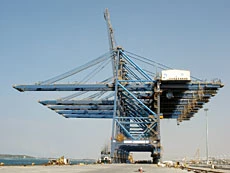
ALKHOBAR: Red Sea Gateway Terminal (RSGT), the new container terminal at Jeddah Islamic Port, has successfully deployed its terminal operating system (TOS).
The Navis SPARCS N4 TOS software has completed operational testing, as RSGT gets ready to receive its first commercial vessel next month. Red Sea Gateway Terminal (RSGT) will be a new world-class container facility at Jeddah Islamic Port. It is the first build-operate-transfer (BOT) port development agreement in the Kingdom. The private sector has invested nearly SR2 billion in RSGT, funded by Saudi banks.
The opening of RSGT should introduce a new era of trade for Saudi Arabia. In recent years the Kingdom’s business community has struggled to overcome the bottlenecks in container handling at Jeddah Islamic Port. The delays led to high costs for freight handling to Jeddah and forced many shipping lines to stop serving the port. When fully operational, RSGT will add 45 percent to the port’s annual capacity, equivalent to an additional 1.5 million twenty-foot equivalent units (TEU). TEU is a standard measure in intermodal transport and relates to the capacity of steel shipping containers. These standard sized containers can be transported by truck, rail or ship.
With a commitment to offering state-of-the art facilities and services, RSGT becomes the first Middle East terminal operator to use the Navis SPARCS N4 TOS from Zebra Enterprise Solutions (ZES), a division of Zebra Technologies Corp. The Web Based SPARCS N4 operating system will govern the movement of all container logistics and operations from the moment a container is scheduled to be unloaded from a vessel until it leaves the terminal’s gate. It offers optimized utilization of RSGT’s container handling equipment. This means that cranes move containers efficiently based on an overall view of the freight that needs to be shifted, combined with the operating business rules of the terminal. This results in fewer unladen moves of the cranes, shorter travel distances for equipment and freight, and lower fuel, labor and maintenance costs.
The Navis SPARCS N4 Expert Decking feature will help to increase the utilization of the terminal’s yard space. With Expert Decking, each container will be assigned to its optimal position based on the business rules and constraints of the terminal, providing up to 90 percent reduction in re-handling of shipments. With the containers being moved less, this leads to lower costs and less chance for damage to the freight.
The terminal operating system is of course fully automated and authorized users, such as vessel owners, will have access to the Navis SPARCS N4 automated crane scheduling and monitoring tools. These will provide real-time views of crane schedules, vessel container moves, vessel activities and vessel labor assignments using Web-based resources.
“SPARCS N4 is a fully integrated solution from gate to yard to vessel, thereby eliminating the manual processes,” said RSGT Project Director Mazen Matar. “It is imperative for RSGT to provide world-class customer service, and with the latest operating system in place, we are confident we will advance business on the Red Sea, offering efficient cargo handling and faster ship turnaround times.”
The success of ZES’ Navis SPARCS N4 terminal operating system at RSGT most certainly played a role in the awarding of a major contract that was announced on Wednesday. Gulf Stevedoring Contracting Company (GSCCO) will implement Navis SPARCS N4 TOS at the Jubail Container Terminal, which is currently being redesigned. GSCCO was awarded the contract in January to develop and manage operations at that terminal. According to Dakheel Al-Nagem, MD at GSCCO, the Jubail terminal is currently being significantly redesigned to prepare for its high-percentage growth in three years. Jubail currently manages about 120,120 TEU per year.
“We expect 2010 to grow to about 400,000 TEU; by 2011 we expect 800,000; and by 2012 we expect 1 million TEU,” Al-Nagem said. “At Jubail, we will have the best equipment and along with that we need a strong and reliable system to complement our infrastructure. We think SPARCS N4 represents a different era. It will allow us to develop a smart reporting system locally and elevate the operations to a different level.”
Comments to: [email protected] or http://twitter.com/molouk