
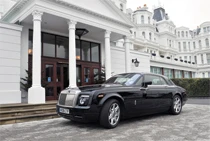
ATTEMPTING to visualize a Rolls Royce “sports car” is as challenging as trying to picture PG Wodehouse’s sartorially immaculate butler Jeeves in a Lycra jogging suit. However outrageous the idea, the common elements linking these two impossibly images is that both parties would carry off the feat with great dignity and style. And it is tradition that features large in the quality and feel of the Rolls Royce Phantom range; the new Coupé is no exception.
The build quality is superb and the advanced technology that BMW have brought to the marque has put the vehicle at the forefront of automotive engineering. It is, to resolve the oxymoron of a Rolls Royce sports car, crisper and firmer in its feel and performance than its stable mates, the Phantom and the Phantom Drop-head — but it loses nothing in luxury, style or dignity of the Rolls Royce tradition.
True to the Rolls ethos, the craft skills — leatherwork, woodworking and painting — are as perfect as ever. Looking at the expanse of wood and leather, one feels that the Rolls workshop must be full of people, all trained by Mr. Chippendale, clad in leather aprons and musing over the selection of wood-grain or hide. That is not entirely untrue, and it results in a vehicle of exquisite quality made uniquely for each owner. Anything you touch in a Rolls is made by Rolls. Mark Court is the painter who puts the immaculate six-meter coach-lines on the bodywork entirely by hand and other paint detailing when needed. He was once flown out to the Middle East for a weekend to add a set of coach-lines to a client’s Phantom. “Six meters is a long distance to get perfectly straight,” he says modestly, “and it takes a lot of concentration.”
As with all Rolls-Royces, the basic structure of the car is made in Germany before being shipped to the purpose-built Goodwood plant for trimming and final assembly. The spotlessly clean workspace has the hushed tones of a library about it. From the visitor’s walkway, you can watch the personnel walk purposefully about their business over gleaming floors. The whole atmosphere is one of focus and concentration.
Into this formidable tradition Rolls have introduced the impossible and integrated an element of sportiness with the Phantom Coupé. The car keeps the ultra-rigid aluminum chassis of the Drop-head Coupé and has stiffer suspension, noticeable as a minutely raised noise level over the Phantom, thicker anti-roll bars and reduced lean through corners.
Whether owners will ever use the “sport” button is debatable. It shuts out top gear and reorders the gear-change options to make the car more responsive. However, in an interior of perfect good taste, it did seem a bit like putting a digital display on a Rolex watch; handy but....hmmmm!
Noticeable in the driving is that the transmission has been tweaked to give later change-up points and quicker downshifts with the sport button holding the gears longer to achieve maximum torque. More positive higher-geared steering together with a thicker, smaller diameter steering wheel adds both to the positive feel and accurate steering.
Although Rolls suggests a 0-100 kph time of about 5.6 seconds, informal tests came out nearer 6.5 — but what does that matter? It is more of a sporting-car than sports-car; no one would buy it for its standing start times. Pushing 2.5 tons of car along that rapidly and deceptively — the acceleration feels nowhere near that quick — is nonetheless quite an achievement.
No owner will worry too much about fuel consumption. Suffice it to say that the Coupé returns about 8km/liter gently cruising and the huge 100-liter tank makes a 600-kilometer range entirely feasible. The Phantom Coupé is a huge car. It takes some getting used to but it is rewarded by the rapid realization that the driver can push the car around. Looking to the rear, the letterbox rear window though restricts rear vision to a neat rectangle 50 or so meters behind the car. I found that slightly awkward and found myself ducking to get a better view.
Getting used to the long hood is one thing; the rear-hinged doors are altogether another challenge. They are huge and require space around the car to open fully. The positive side is that they make getting out very easy and, for female drivers or passengers, elegant. Closing them is achieved by pressing a neat button just below the front quarter light; they have the solid feel and weight of a bank vault door. Perfect!
The Coupé’s profile clearly reflects that of the Drop-head, with the traditional vertical radiator and, unusually for a Rolls, visible exhaust outlets. As with the Drop-head, the two-piece trunk lid drops down to form a solid bench seat ideal for the odd picnic. The elegantly flowing roofline, letterbox rear window and overall proportions are altogether very pleasing.
“At last,” observed an Eastbourne passer-by old enough to know about such things, “Rolls have arrived in the 21st century.” They have and in some style.
Swinging through the tight corners of damp West Sussex lanes the Coupé showed remarkable agility derived from the combination of perfectly tuned suspension and the vast amount of torque from the 6.75 liter V12 BMW engine that fed 435 bhp seamlessly into the six-speed automatic box. The resulting acceleration is the closest you will get, while still on the ground, to an aircraft.
Braking is powerful, the bite being slightly sharper than that of its sister Phantom Saloon because the Coupé was designed to be driven by the owner.
The leather interior of the Coupé is nicely redolent of gentlemen’s club. The front seats are huge, suitably firm and very comfortable. All said and done, these are rare cars both in number and in quality and truly beautiful things to behold.