
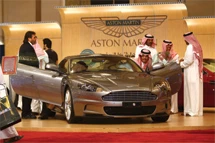
THE stable economy, a high flow of liquidity, a rising population growth rate and the fact that the local production of automobiles is nonexistent are the key factors behind the significant growth of the automotive sector in Saudi Arabia.
The diversified automotive industry in the Kingdom, like in the rest of the Gulf Cooperation Council states, is wholly dependent on imports from America, Europe, Japan, Korea and other Asian countries. The large presence of automobiles in the region creates significant demand for the spare parts industry.
The Kingdom has consistently witnessed a growing demand for new cars due to the rising youth population and the habit among Saudi families to change their cars every two to five years. With thousands of cars, vans and trucks either destroyed or damaged in Jeddah’s flashfloods on Oct. 25, it is generally felt that this will additionally raise the demand for new or used vehicles in the coming days and months.
Market leaders say that automobile sales in the Kingdom and elsewhere in the GCC continue to maintain the growth trend started in March, with many distributors reporting better-than-expected results. In some cases, this is feeding into further expansion of existing products and developing new ones. “While there are still challenges in the form of restricted credit and reduced liquidity, the problems of global manufacturers are unlikely to affect the regional markets,” a major car importer said.
These are among the issues that the international car exhibitions being held annually in Riyadh and Jeddah have been addressing, said Zahoor Siddique, exhibitions director at Al-Harithy Company for Exhibitions. “The success of the annual Saudi International Motor Show hosted in Jeddah since 1978 can be gauged from the fact that it entered its fourth decade this year,” he added.
The exhibition held in Jeddah recently — like the Riyadh Motor Show 2009 that opens in the capital on Saturday and will run through Dec. 16 at the Riyadh International Exhibition Center concurrently with Saudi AutoShop 2009, the 13th international exhibition for auto repair equipment, tools, parts and accessories — provides rare marketing opportunities to the car industry sector through which they demonstrate their new innovations and launch new products.
The developments largely support the view that growth in the Saudi economy, along with liquidity injections and sales, should see it grow by over two percent this year. Overall, it is expected that by the end of 2013, sales should be up by nearly 50 percent compared with 2008 levels.
Market revival from 2010 will be spurred on by increased lending, with car loans to rise from under 50 percent to over 70 percent of car sales, which has been typical of other Gulf markets. After tepid growth in 2009 in the value of total car sales of around $600 million from 2008, in the 2010-2013 period growth in the value of auto sales will be more robust.
The value of sales is expected to reach $18.53 billion in 2010, a $2 billion increase over 2009, and will rise further to $20.37 billion in 2011, $22.73 billion in 2012 and $25.05 billion in 2013. Between 2010 and 2013, the number of vehicle units sold in Saudi Arabia is forecast to increase from 676,000 to 880,000, an increase of around 30 percent.
Results for some major auto companies have been encouraging. For instance, Ford Motor increased its sales by 13 percent in March in Saudi Arabia, tracking similar sales increases for the US motor giant in certain other parts of the Gulf.
Although sales for the first half of 2009 were well down compared to the same period in 2008, the decline has not been as dramatic as was expected earlier in the year when the sector’s fundamentals were particularly weak.
Used cars are also increasing their share of the Saudi market. In fact, new rules have been implemented by the Saudi Customs Department setting the maximum age for imported used vehicles at five years. The regulations cover cars, buses and light commercial vehicles (LCVs), while the age limit for heavy vehicles is 10 years. This should impact the sale of used cars.
It is now an established fact that women play a major role in car purchases. In Jeddah and other larger cities of the Kingdom it is common for women to visit car showrooms, and women are often the ones who select the vehicles in which they want to be chauffeured.
The marketing director of a leading Saudi car dealer says 15 percent of Saudi women are the buyers. And as the value of the car increases, women play a more active role. According to industry watchers, women buy one in five luxury sedans. “About 480,000 new cars entered the Saudi market last year, 25,000 of which were sold to women,” he said.
A sales representative from a major car-finance company says women make purchasing decisions based on spaciousness, safety and overall appearance. “Working, middle-income women expect a car to last a long time,” he added.
The purchasing power of Saudi women is perhaps one reason why the car showroom is an open venue for men and women. Showroom sales representatives say that women are often the ones making the choice for vehicle options and colors. A sales representative of a popular brand says ladies could be picky when it comes to appearance and they are more likely to be finicky and select options that add to the price tag. “Pearl, gold and black are colors that fascinate ladies a lot,” he said, adding, “Ladies tend to prefer tinted windows, too.”
The Saudi car market, which runs into billions of riyals, has been witnessing tough competition between companies to win new dealership of overseas manufacturers. Saudi Arabia is the largest car market in the Middle East with an annual growth rate of three to seven percent. There are more than 10 million cars and buses on Saudi roads, according to authentic reports.
Continued on Page 12