
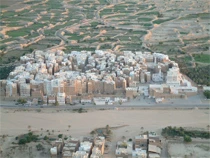
Some called it “the cake”, while others called it the “Manhattan of the Desert.” Those descriptions were among the immediate reactions from flabbergasted and breathlessly delighted visitors. Shibam in Yemen’s Hadhramaut is a showpiece of mud architecture and supposedly had the world’s first skyscrapers. The city took its name from a historical figure, Shibam bin Al-Hareth from the family of Sheba. Even though, the entire city is made of mud and clay, it has withstood all hazards for centuries to testify to stories of the greatness of the Yemeni people.
In October 2008, destructive rains and flash floods swept Hadhramaut and as Shibam was built of mud, many heritage lovers held their breath, waiting for the fate of the city after the 30-hour rain. Out of the blue, the city narrowly escaped danger; however, this doesn’t mean that the danger is over. The city is still living with the consequences of the rain. Arab News visited Shibam to have a close look at the dangers and problems facing a city that is internationally admired. In the narrow streets of Shibam, I looked and wondered: Is Shibam ready for any kind of disaster?
The distinctive feature of the city is its liveliness. Unlike many other historical sites where tourists find only walls and statues, visitors to Shibam will find a bustling city. However, after the floods, many locals found themselves thinking about leaving for good, even though their fondest memories were rooted in the city.
Alawi Bin Sumait, a journalist and a citizen of the city, told Arab News that there were many problems facing the city and if they remained unsolved, people would be forced to leave the city. He says, “The houses of Shibam are experiencing severe natural erosion, from both rain and wind. The process of reconstruction is difficult and slow and needs a lot of effort. We must of course preserve people by providing them with facilities and that will save the city too.” Some of the natives of the city have chosen to leave and live outside the city. Bin Sumait says, “The increase in the number of family members has forced many people to build houses outside the main city but they remain in touch with it.”
When the floods hit the city in 2008, Shibam was turned into something like an island with many people surrounded by water. “We couldn’t find a doctor because most of them are from outside the city. Water and electricity were cut off and we couldn’t find even a candle. In neighboring areas, people climbed mountains to escape the flood, but we had no choice but to wait for whatever destiny held for us,” Bin Sumait says. He believes that the October 2008 floods represent a watershed in the history of the city in which the stakes were increased immensely. “What made the city survive was its location on a high place. The city is now in several water courses. If these currently blocked courses are not cleared, the city will not, it cannot, survive another flood. History tells us that the city was destroyed once a long time ago,” Bin Sumait warns.
He says that Shibam, in 1982, was one of the first Yemeni cities to be included as a World Heritage Site. “In that year, both Sanaa and Shibam were listed as world heritage sites. It is a lively city — both intellectually and commercially — and has maintained its special architecture for ages. “The population of Shibam doesn’t exceed 3,000 and they live in a total of 500 houses. Most of them work as farmers, taxi drivers and shopkeepers.
Jamal Bamakhramah, manager of the General Authority for Preserving Historical Cities (GAPHC) in Hadhramaut, told Arab News that the possible collapse of the city’s wall poses a great challenge. “The wall is not only for defending the city against raids but it also serves as a buttress for the city. The houses of the city are architecturally built adjacent to each other and if one collapsed, others would follow.” Bamakhramah agrees with Bin Sumait that the blocked flood courses also pose a great threat to the city. He says, “If another flood with the strength of the last strikes Hadhramaut, it will definitely destroy the city. Water courses are blocked with trees and sand and they require quick clearing action.” He believes the city is not ready for a new disaster. Even a flood that is far less destructive than the earlier one would wipe the city out.”
Bamakhramah added that 234 houses out of 500 were affected either partially or totally by the rain. His office sent a report to the Social Fund for Development (SFD), which sent $315,000 for reconstruction.
Many reconstruction projects are under way in the city. One involves renovating the houses. In fact, three organizations are helping to fund the projects — GAPHC, SFD and the German Development Program (GTZ) plus the local people. These organizations are helping defray the costs of reconstruction; one house can take up to $5,000.
Another vitally important project is improving the city’s infrastructure, including the drainage and drinking water systems. Bamakhramah applauded the local people and described them as supportive: “The secret behind our success and progress in our work is support and assistance from the people of Shibam.”
He added that lack of cash was the most serious problem his office has to deal with.