
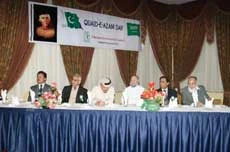
As Pakistanis and Saudis gathered in the Eastern Province to remember Pakistan’s founder Quaid-e-Azam Muhammad Ali Jinnah, speakers said his vision of the nation when it was founded should be used to guide the country through its current troubles.
“His diplomatic skills and political skills were unparalleled. It was thanks to his brilliant skills that he managed to create a Muslim nation against all odds,” Pakistani Ambassador Umar Khan Ali Sherzai said of Jinnah. “What do his ideals teach us? What was his message? Unity, faith and discipline. Unfortunately, we Pakistanis are divided on the basis of provincialism and parochialism. Yes, we come from different provinces, but that shouldn’t mean we allow those divisions to wreak havoc.”
Sherzai, who comes from the Federally Administered Tribal Areas (FATA), said Pakistan was strong enough to weather the current conflict with extremists on the frontier. “Our armed forces have done a tremendous job in rooting out extremists from those areas. We should not be disappointed with the current state of affairs. All countries pass through such turbulence,” he said. “These suicide bombers are absolutely desperate after suffering a massive defeat. They are the enemies of Islam and the enemies of humanity. We will get rid of them soon. To our enemies, the message should be clear: Don’t underestimate the Pakistani nation’s resilience.”
The Pakistani Community Council (PCC), an umbrella organization of nearly all Pakistani parties, social and welfare organizations, and professional forums, organized the event at Dhahran International Hotel during the weekend. Important members of the Eastern Province Pakistani expatriate community, including successful businessmen, managers, engineers, top executives, researchers and academics, attended. They included Al-Mojbil Managing Director Syed Waseem Hyder, veteran Saudi Aramco driller Iqbal Ahmed and Al-Tuwairqi Holding Co. CEO Tariq Barlas. Other successful Pakistani attendees had associations with King Fahd University of Petroleum and Minerals (KFUPM), Prince Muhammad bin Fahd University, King Faisal University and other top Saudi business establishments.
Saudi luminaries such as Arab News Editor in Chief Khaled Almaeena, Al-Hussan Group President Rashid Al-Hussan and Vice Rector (Academic Affairs) at Prince Muhammad bin Fahd University Dr. Nassar Sheikh also attended.
In his keynote speech, Almaeena was blunt in his criticism of the current state of affairs in Pakistan. “If Quaid-e-Azam were alive today he would have wept at what is happening in the country of his vision,” he said. “What is happening to his ideals? It was at his call that hundreds of thousands of Muslims left the comfort of their palaces to live in huts in Karachi and in Lyari and other cities of Pakistan.”
Almaeena said Quaid-e-Azam’s sacrifices needed to be remembered, acknowledging the programs Pakistanis organize each year to commemorate his founding of the country. “But then the question I want to ask of Pakistanis is: When are they going to walk the talk? It is more than 60 years now, and the country is horribly divided between Mohajirs and non-Mohajirs, Punjabis and Sindhis. This is not what Pakistan was created for.”
Almaeena elaborated on Jinnah’s core philosophy, calling him a genius who was concerned about the minorities of Pakistan and who was not in favor on forcing people to follow a particular ideology. “Pakistan came into being under extraordinary circumstances. It was to be a model Muslim state where the minorities were to be accorded complete protection. Things have reached such a point that many Pakistanis, especially young Pakistanis, do not hesitate these days to ask the taboo question: Why Pakistan? Why was it created? You can’t blame them,” he said. “With all that is happening around them they are confused. Instead of saying ‘Pakistan zindabad’ (Long live Pakistan) now they are saying ‘Pakistan se zinda bhaag’ (Run alive from Pakistan). This is not a joke but a sad reality.”
He said Pakistanis had a “God-given talent” and they should be proud of their country for many reasons including rich mineral resources, fertile land, a vibrant media, an active civil society and, of course, the nuclear bomb.
“You are no less than anybody. Raise your head high. Pakistan is a source of strength to the Ummah. You can do it, and you have done it,” he said. “You are the citizens of a resilient nation. Don’t let your morale be affected by what is happening today. But the silent majority that believes in the vision and ideals of Quaid-e-Azam must stand up and say: ‘Enough is enough.’ Stand up against tyranny. Allow better sense to prevail.”
Prominent Pakistani businessman Tariq Barlas suggested the creation of a fund to train 10 young entrepreneurs from Pakistan and 10 from Saudi Arabia. “This will be a great service to the future generation of the two countries. Let us join hands and strengthen the economic cooperation between our two countries,” he said.
He urged Ambassador Sherzai to make it easier for Saudi businessmen to operate in Pakistan, blaming bureaucracy for preventing more investment from the Kingdom.
In his concluding address, PCC President Sajid Khan Abbasi reiterated that Pakistan is a resilient nation. “It was because of this resilience that it came into being in the first place. However, for the nation to thrive it is incumbent that Pakistanis themselves take the lead and do what is necessary to put their country back on the path to progress.”
Jawaid Inam, who was mainly behind the organization of the event, was the anchor. A successful businessman, Inam praised the Pakistani community for coming together for a good cause and an event that has high symbolic value. “A message has gone out that we Pakistanis in the Eastern Province can rise above our political differences and come together,” he said to thunderous applause. He credited the success of the event to the entire PCC team.
Ambassador Sherzai put the global importance of warm relations between Saudi Arabia and Pakistan in perspective. “Saudi Arabia and Pakistan are two strong pillars of Islam. If Pakistan is strong, Saudi Arabia is strong. And when Saudi Arabia is strong, Pakistan naturally feels stronger. Such is the nature of our relationship,” the ambassador said. “We will sacrifice the last drop of our blood to defend the sovereignty of Saudi Arabia. We will never let Saudi Arabia down.”