
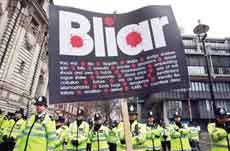
LONDON: Former Prime Minister Tony Blair acknowledged Friday that Saddam Hussein didn’t become a bigger threat after Sept. 11, but said his perception of the risk posed by terrorists acquiring weapons of mass destruction was dramatically changed by the attacks. He insisted he had backed war because Saddam had flouted UN resolutions, not because he wanted “regime change.”
Blair told Britain’s Iraq Inquiry that his contentious decision to back the 2003 US-led invasion of Iraq was inspired by fears of another, even deadlier, terror attack.
“It wasn’t that objectively he (Saddam) had done more, it was that our perception of the risk had shifted,” Blair said. “If those people inspired by this religious fanaticism could have killed 30,000, they would have. From that moment Iran, Libya, North Korea, Iraq ... all of this had to be brought to an end.
“The primary consideration for me was to send an absolutely powerful, clear and unremitting message that after Sept. 11 if you were a regime engaged in WMD (weapons of mass destruction), you had to stop.”
Blair was questioned about charges that his government was so determined to topple the Iraqi dictator that they exaggerated the content of intelligence reports on Iraq’s supposed weapons of mass destruction. He was pressed on when exactly he offered US President George W. Bush support for an invasion.
The former British Amb-assador to Washington, Christopher Meyer, said it appeared that an agreement was “signed in blood” by Bush and Blair at the president’s ranch in Crawford, Texas, in April 2002.
“The only commitment I gave (at Crawford) was a commitment to deal with Saddam,” Blair said. He said he told Bush “we will be with them in dealing with this threat.” Blair said other world leaders did not feel the same way he and Bush did.
“Although the American mindset had changed dramatically (after Sept. 11) — and frankly mine had as well — when I talked to other leaders, particularly in Europe, I didn’t get the same impression.”
Blair denied he had pledged Britain’s support for war during the private meeting with Bush in Crawford, Texas, saying he had told Bush “we are going to be with you in confronting and dealing with this threat” posed by Saddam’s suspected program of weapons of mass destruction.
“How we did that was an open question, and even at that stage I was raising the issue of going to the UN,” he said. If military action was the right way, Britain wanted to be “in there right alongside” Washington, he told the inquiry.
Blair admitted that a key British government dossier of intelligence about Iraqi WMD in September 2002, which helped make the case for war, could have been clearer.
He said the central claim Saddam could launch WMD within 45 minutes should have been “corrected.”

