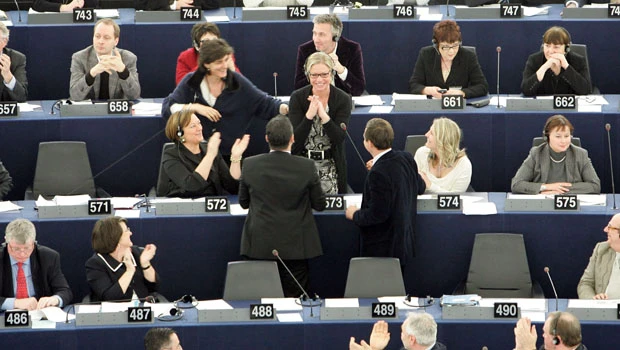
- STRASBOURG, France - Future anti-terrorism cooperation between the European Union and the US hung in the balance Thursday, after the European Parliament rejected a controversial deal that would have let the two sides of the Atlantic share banking data.
Under the so-called SWIFT agreement, the United States could collect EU citizens' banking data for anti-terrorism investigations, and then provide EU governments with intelligence on suspicious movements.
A nine-month interim version of the deal came into force on February 1, but EU deputies in Strasbourg decided to annul it by a wide margin, with 378 votes in favor, 196 against and 31 abstentions.
"Let's enjoy this historic moment," said parliament vice-president Libor Roucek, who presided over the vote.
Deputies were incensed that EU governments concluded the SWIFT deal on November 30, just a day before a new EU treaty gave them an increased say on the matter, and shared its contents with MEPs on January 26, just five working days before the agreement came into force.
In addition, the coalition who rejected the deal - socialists, liberals, greens and left-wingers, plus renegade German and Austrian conservatives - thought data protection safeguards were insufficient, and were unimpressed by EU governments' pledges to involve parliament in talks over a permanent SWIFT deal, due to start in the coming weeks.
"This house cannot keep falling for vague promises," said Jeanine Hennis-Plasschaert, a Dutch deputy, who drafted the report responsible for the sinking of the SWIFT deal. She added that were the US congress in the European Parliament's shoes, it would have also shot down the agreement.
The reaction of the EU's executive, the commission, left it in doubt whether a new data-sharing agreement would now be possible. A statement said it would "need to explore with the United States Treasury Department the extent to which there is scope to negotiate."
The US embassy in Brussels said the parliament's vote "disrupts an important counter-terrorism programme" and represented "a setback for US-EU counter-terror cooperation." But said nothing on restarting negotiations on a new deal.
Parliament's vote went ahead despite a last-minute attempt by the conservative European People's Party (EPP) to put it off. The request was supported by a smaller parliamentary faction, the European Conservatives and Reformists (ECR), but 305 members of parliament (MEPs) rejected it, against 290 in favor and 14 abstentions.
The European commissioner for home affairs, Cecilia Malmstrom, tried in vain to appease deputies, saying they would be "fully involved" in the talks over a new and improved deal, which would be concluded "as soon as possible."
In exchange for a postponement, she said parliament would receive an EU draft negotiation mandate on the same day it was approved by the commission, on February 21. EU governments would get to see it only a day later, Malmstrom stressed.
But it was not enough to calm parliament's spirits. Hennis- Plasschaert, said "the security of EU citizens will not be compromised" by a 'no' vote, as the US could still access SWIFT data through EU national governments' channels, leaving no security gap.
EU and US governments, as well as the commission, suggested otherwise.
"If we reject this agreement, I think we will all be a little less secure," Spanish Interior minister Alfredo Perez Rubalcaba, representing the EU's current presidency, warned Wednesday, during a debate in the parliament's chamber in Strasbourg, France.
Perez Rubalcaba said SWIFT data were used to investigate the al-Qaeda-inspired Madrid bombings of March 11, 2004, which killed 191 persons, and to prevent another attack on Barcelona.
The parliament's veto to SWIFT showcased its increased status under the Lisbon Treaty, that reformed the EU's workings when it came into force in December. But the vote could also stress ties with the US at a time when EU leaders are still reeling from President Barack Obama's decision to snub a planned EU-US summit in May.