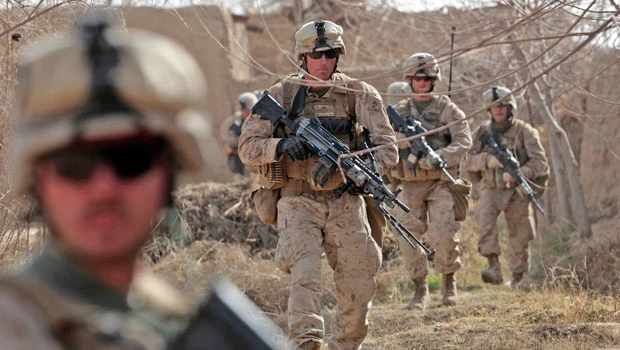
- MARJAH: The Afghan military said on Monday that US-led troops had taken almost full control of a key Taleban bastion on the third day of a major ground and air assault in Afghanistan.
The offensive is the first major test of US President Barack Obama's strategy to reverse the Taleban insurgency and end the eight-year war and one of the biggest since the 2001 US-led invasion brought down the Taleban.
US Marines were leading 15,000 US, NATO and Afghan troops in the ground and air operation designed to clear the Taleban from the Marjah region of the southern province of Helmand and make way for Western-backed authorities.
A military spokesman said US Marines are making steady progress but areas infested with roadside bombs are bogging them down.
“We are making steady progress, but being very methodical about detecting and clearing routes in an area heavily saturated with IEDs (Improvised Explosive Devices),” Marine Capt. Abraham Sipe told Reuters in response to an e-mail, adding counts of militants killed of captured would not be provided.
Afghan officials said on Sunday that as many as 35 militants had been killed in the first two days of the offensive.
"In many parts of Marjah, we have seen very little opposition. There are areas where Marines have met with stiff resistance, but they are making steady progress throughout the area," Sipe said.
Afghan officials said there had been some fighting.
"There was fighting last night and some sporadic clashes are still going on in Marjah. The enemy has suffered casualties," said Ghulam Mahaiuddin Ghori, a senior Afghan Army general in Helmand.
Afghanistan is a top foreign policy issue for Obama so failure here could be seen as damaging to his presidency.
Much of the operation's success in Helmand province depends on whether the administration wins residents' trust and Afghan troops must be able to keep the Taleban from returning.
NATO and the Afghan government’s credibility rests on limiting civilian casualties, especially as NATO commanders told Marjah residents to stay home during the offensive.
Highlighting the dangers of fighting a resilient and unpredictable enemy, Helmand Province Gov. Gulab Mangal said three would-be suicide bombers were gunned down on Sunday while trying to blow themselves up among troops.
"The situation moment by moment is going the way the government had expected. The forces are extending their advances from points they have captured and the operation is going on successfully," he told a news conference.
The Taleban could not be reached for comment on Monday.
But in a statement on the 20th anniversary of the withdrawal of defeated Soviet troops from Afghanistan, after battling Western-backed Mujahedeen fighters for nearly a decade, the Taleban said: "The current occupiers of Afghanistan, like the Red Army, will face defeat.
"Twenty years after the defeat of the Red Army, today Obama, also in Afghanistan, has given one-and-a-half years to the commander of foreign invaders, (NATO Commander US Gen. Stanley) McChrystal, to prove his success against the Islamic Emirate."
NATO rockets killed 12 civilians on Sunday, the second day of a drive to impose Afghan authority on one of the Taleban's last strongholds in the country's most violent province.
The offensive has been flagged for weeks to persuade Taleban fighters to leave so the area can be recaptured with minimal damage or loss of civilian life, in the hope that the roughly 100,000 people there will welcome the Afghan administration.
Marjah, an area of farmland criss-crossed by canals, has long been a breeding ground for insurgents and lucrative opium poppy cultivation, which Western countries say funds the insurgency. Taleban officials accuse NATO of hyping up the importance of the district to make up for past losses.
The attack started on Saturday with waves of helicopters ferrying troops into Marjah and nearby Nad Ali district. The next day, US Marines came under intense fire.