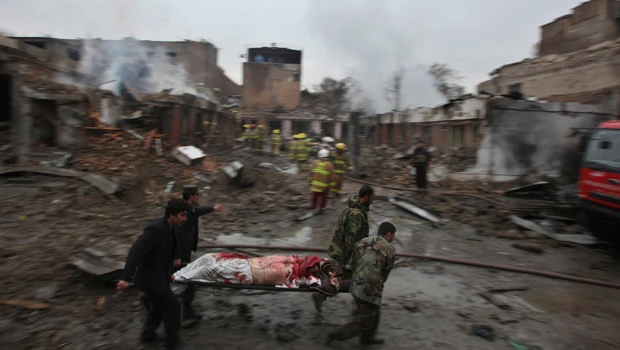
- KABUL: Insurgents struck in the heart of the Afghan capital on Friday with suicide attackers and a car bomb targeting hotels used by foreigners and killing at least 16 people and wounding dozens.
The Taleban claimed responsibility for the attacks, which Afghan President Hamid Karzai said were aimed at Indians working in Kabul.
The Taleban has long opposed India's involvement in the country and its ties to the Northern Alliance that helped the US oust the Taleban regime in 2001 and formed the backbone of Karzai's government.
Six Indians were killed in the attacks, a spokesman for India's Foreign Ministry said, revising the number from the ministry's original estimate of up to nine Indians dead. An Italian diplomat and a French filmmaker were also among the dead. Three Afghan policemen were killed, and six more officers were among the 38 people wounded, the Afghan government said.
The four-hour assault began about 6:30 a.m. with a car bombing that leveled a residential hotel used by Indian doctors. A series of explosions and gunbattles left blood and debris in the rain-slicked streets and underscored the militants' ability to strike in the heavily defended capital even as NATO marshals its forces against them in the volatile south.
Dr. Subodh Sanjivpaul of India said he was holed up in his bathroom for three hours inside one of the small hotels where he lived with other Indians. “Today's suicide attack took place in our residential complex,” Sanjivpaul said at a military hospital where his wounded foot was bandaged. “When I was coming out, I found two or three dead bodies. When firing was going on, the first car bomb exploded and the full roof came on my head.”
The Kabul attacks came two weeks into a major offensive against the southern Taleban stronghold of Marjah, where thousands of US, Afghan and NATO soldiers are battling to drive insurgents out. The British government said one of its soldiers was killed Friday by an explosion while on a foot patrol — the 14th NATO service member to die in the operation.
In a statement, Karzai condemned Friday's assault as a “terrorist attack against Indian citizens” who were helping the Afghan people. He said it would not affect relations between India and Afghanistan.
Indian Foreign Minister S.M. Krishna called the attacks “barbaric” and a matter of “deep concern.” “These are the handiwork of those who are desperate to undermine the friendship between India and Afghanistan,” he said in a statement.
The Indian Embassy in Kabul has been the target of two major attacks, one in July 2008 that killed more than 60 and another last October that killed 17. India accused archrival Pakistan's main spy agency of involvement in the July 2008 attack.
Afghan Interior Ministry spokesman Zemeri Bashary said three attackers were involved in Friday's assault, although the Taleban said there were five suicide bombers.
In a call to The Associated Press hours after the initial blast, Taleban spokesman Zabiullah Mujahid said the attackers were “targeting two places used by foreigners.” He did not specifically mention Indians.
Kabul Police Chief Abdul Rahman told reporters the attacks started with a car bomb that exploded outside the Arya Guesthouse where Indian doctors stay. Some work at the Indira Gandhi Child Health Institute in the city.
The blast leveled the building, also known as the Hamid Guesthouse. After the car bombing, a suicide attacker detonated his vest of explosives outside the demolished building.
Two other attackers then entered a second hotel known as Park Residence. Police surrounded the building. One of them holed himself up in a room and then blew himself up, killing three police officers and wounding six others. The other attacker was shot dead by police.
An Italian diplomat who worked as a counselor to the Italian premier's office was among those killed, Italy's foreign minister said. The Frenchman killed was identified as filmmaker Severin Blanchet, who had trained young Afghans on documentary filmmaking since 2006, the French Foreign Ministry said.