
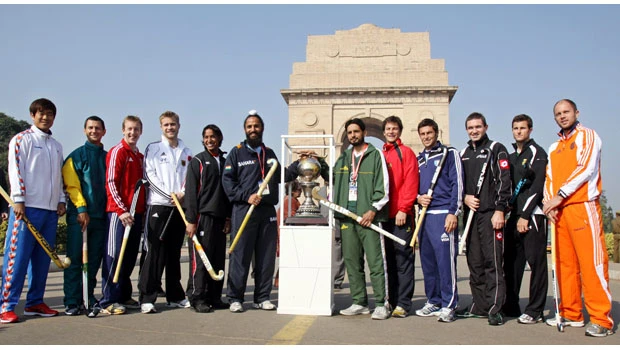
- NEW DELHI: Max Muller's young German team will begin its bid for a hat-trick of World Cup titles amid a heavy security blanket this week comprising 19,000 staff protecting a 3-kilometer radius of the venue and accommodation for the 12 competing nations.
Apprehensions about security following recently reported threats by some terrorist organizations against athletes visiting India have been eased for many teams this week since entering the multi-cordon security set up in New Delhi.
“There were serious concerns about putting hockey players where their life is threatened when all they want to do is play hockey,” England team manager Andy Halliday said of the media reports. “So we went through a rigid investigation of the security arrangements and we've been happy with what we see here.” Security staff, including police and a paramilitary force, are covering the team hotels - where all staff and guests must pass through metal detectors and security checks - travel routes and match venues.
New Zealand captain Phillip Burrows said one of his players withdrew from the squad before the team left for India and other players were worried about the security.
“Most of them were worried, but we're happy with the security provided to us,” Burrows said.
Specific threats were reportedly made against the Australians, reportedly by a group seeking to retaliate against recent attacks on people of South Asian origin in Melbourne.
But the Australians have sent a full team and are considered by many to be the favorite to lift the title.
Australia is the top-seeded team in Group B and opens the tournament against European champion England on Sunday, when archrivals India and Pakistan meet and 2008 Olympic silver medalist Spain takes on South Africa.
Group A will open Monday with Germany against Asian champion South Korea, Netherlands against Argentina and New Zealand vs. Canada.
Germany won the 2002 and 2006 World Cups but its squad in India contains only three World Cup veterans.
Captain Muller is not bothered, saying Germany had fielded similarly young lineups in the past two World Cups.
“We're not looking at history, our performance here is what will matter in this World Cup,” he said. “Germany is a relatively young side, but then we won the 2002 and 2006 World Cups with different teams,” he said.
Matthias Witthaus, Moritz Furste and Jan-Marco Montag are the only players from the 2006 champion team left in Germany's squad that went on to win the Olympic title at Beijing in 2008.
Since its 2002 World Cup triumph in Kuala Lumpur, Germany's most formidable opponent has been Australia, which clinched its first Olympic Games gold medal at Athens in 2004.
The Australians rallied from a two-goal deficit at halftime to beat Germany 5-3 in the final of the Champions Trophy in December.
“Australia seems everyone's favorite for the title,” Muller conceded. “The Australian team is looking in very good form.” Striker Jamie Dwyer, the 2009 world player of the year and a 2004 Olympic champion, will lead an Australian team that is coached by Ric Charlesworth, a former World Cup winner.
The strike-power of Grant Schubbert and Edward Ockenden will lend support to Dwyer along with penalty corner specialist Luke Doerner, who scored two goals to shape the turnaround for Australia in the Champions Trophy final.
The Dutch are hoping to recreate the form that saw it win three major titles between 1996 and 2000 - two Olympics and a World Cup.
Seasoned goalkeeper Gus Vogels has two Olympic gold medals and would like a World Cup title to go with them.
“A World Cup gold medal is all that's missing from my medal collection,” said Vogels, who plans to retire after this event.
Tuen de Nooijer, among the game's best midfielders in the past decade, and penalty corner specialist Taeke Taekema will bolster the Dutch attack.
Spanish skipper Pablo Amat is hoping to go one better than his two Olympic silver medals.
England's European Cup title has revived hopes it can repeat its run of the 80s, when it reached the 1986 World Cup final and won the 1988 Olympic gold in Seoul.
Two injuries in the last week have been a setback, but England captain Barry Middleton says his team has the ability to advance at least to the semifinals.
Pakistan is the most successful nation in World Cup history, winning the title four times, but its last triumph came in Sydney in 1994.
The decline of Pakistan and India has taken the spotlight away from the subcontinent, which dominated world hockey for more than half a century.
India's lone World Cup title came in 1975. Since then, India has slipped in the rankings, occupying the ninth, 10th and 11th positions in the last three World Cups.
India won the last of its eight Olympic gold medals in the boycott-hit Moscow Olympics of 1980. Since then, it has not managed to even enter the semifinals of seven Olympics and World Cups spread over three decades.
After failing to qualify for the Beijing Olympics, India is hoping the its team will produce a better show with the backing of the home crowd.