- PARIS: French President Nicolas Sarkozy pledged euro3 million ($4 million) in emergency aid Monday after hurricane-force winds triggered extensive floods that killed at least 59 people in western Europe.
- Nearly a dozen others were still missing.
The storm, called Xynthia, blew into France early Sunday, flooding ports, destroying homes and leaving 1 million households without electricity. It also battered Belgium, Portugal, Spain and parts of Germany.
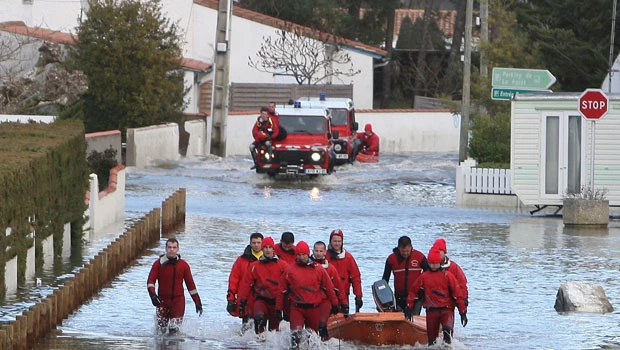
More than 9,000 firefighters and other emergency rescue workers were going house-to-house Monday in France's hard-hit Atlantic coastal regions of Vendee and Charente-Maritime, searching for those still stranded and additional victims, Interior Minister Brice Hortefeux said.
The French death toll from the storm rose to 48, and Hortefeux told France-Info radio on Monday it would "doubtless" increase.
The spokesman of France's emergency services, Lt. Col. Patrick Vailli, said nine people were still missing and scores more were wounded.
The storm also caused six deaths in Germany - including a 2-year-old boy who drowned after he was blown into a river. Three people were dead in Spain, and Belgium and Portugal had one fatality each.
The storm also snarled train and air travel throughout the continent, with major delays on France's railways and continued cancellations Monday at Frankfurt airport - one of Europe's most important hubs.
Sarkozy flew over parts of Vendee and Charente-Maritime on Monday and met with officials and residents of the coastal town of L'Aiguillon-sur-Mer, where sea walls broke and ocean waters surged to the roofs of some homes. The French president promised to declare a natural disaster area and quickly channel the recovery funds.
Local officials say the extensive damage underscores the urgent need to upgrade France's aging sea walls and more strictly enforce coastal building codes.
"The sea wall that broke dated from (the era) of Napoleon," Philippe de Villiers, a far-right politician who heads the regional government in Vendee, told France-Info. "Either we build (new) sea walls, in which case they need to be taller and taller ... or we have to build further" inland.
In Portugal's Azores islands, a flash flood swept a school bus off a road. The driver and one child are missing on Sao Miguel, one of the archipelago's nine islands.