
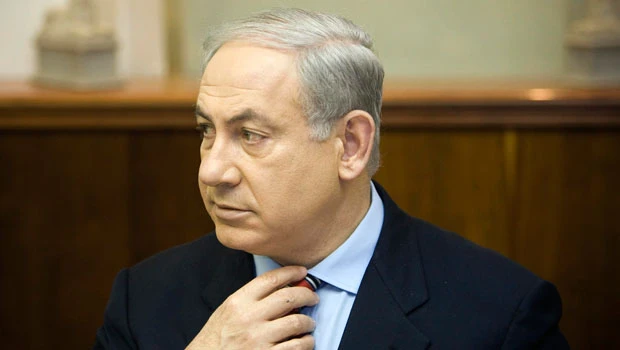
- JERUSALEM: Israeli Premier Benjamin Netanyahu said Thursday he hoped indirect talks between Israel and the Palestinians would begin with the visit of US mediator George Mitchell next week.
"We welcome the start of talks, even if they are proximity talks," he told a cabinet meeting in Jerusalem, a day after the Arab League gave the green-light for indirect Israeli-Palestinian negotiations, albeit with a four-month deadline.
The Israeli leader said Israel's goal was "to reach a peace agreement with our Palestinian neighbors via direct talks," but., he added, "we do not necessarily insist on this format."
"If this is what is necessary to start the process Israel is ready," he said.
Direct Israeli-Palestinian talks were suspended in late 2008, when Israel began an election campaign, which ultimately saw Netanyahu replace the centrist Ehud Olmert as prime minister.
The negotiations have not been resumed since Netanyahu was sworn into office at the end of March 2009. Palestinian President Mahmoud Abbas insists that Israel halt completely all construction in West Bank settlements and in East Jerusalem before he will return to the negotiating table.
A 10-month partial moratorium on settlement construction declared by Netanyahu at the end of November last year was deemed insufficient by the Palestinians, since it was limited in scope and did not include East Jerusalem, which Israel sees as part of its united capital.
Frequent visits to the region by Mitchell, who shuttled between Jerusalem and Ramallah, failed to break the impasse.
The envoy is slated to arrive in Israel again on Saturday night, ahead of a visit by US Vice-President Joe Biden, who arrives Monday.
Netanyahu has set five conditions for peacemaking with the Palestinians. These are:
. Palestinians must recognize Israel as a Jewish state.
Palestinians say such recognition could be perceived as ruling out a "right of return" for Palestinian refugees to land now in Israel. They say they are also mindful of the rights of Arab citizens of Israel.
2. Palestinian refugees must be resettled outside Israel.
Palestinians have long demanded that refugees who fled or were forced to leave in the war of Israel's creation in 1948 should be allowed to return, along with millions of their descendants. But Palestinian negotiators have signaled they would accept "a just and agreed-upon" solution for refugees as laid out in a UN resolution that mentions compensation for those who settle elsewhere.
3. The final peace agreement will end the conflict, and Palestinians can make no further demands on issues such as borders and refugees.
The Palestinians seek a final, lasting agreement that would meet all their national aspirations.
4. The Palestinian state must be demilitarized so as not to threaten Israel.
The Palestinians do not object to this demand, but say it should be discussed in negotiations with Israel.
5. Foreign backing, in the form of explicit international guarantees, for these security arrangements.
The Palestinians say the issue can be sorted out in peace talks, as it was agreed upon in previous internationally backed agreements like the 2003 "road map.”