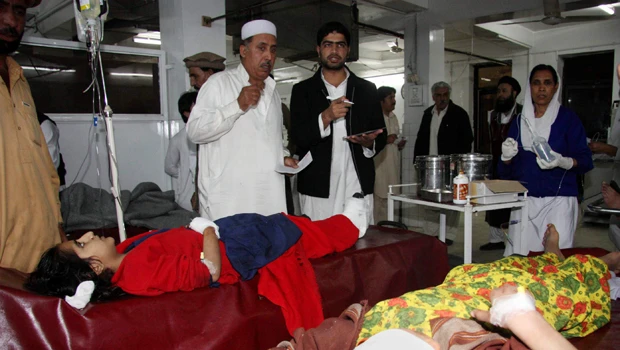
- HANGU, Pakistan: A suicide bomber attacked a convoy of civilians guarded by security forces in Pakistan's northwest on Friday, killing at least 12 people and wounding 30, police said.
Suicide bombings have eased in recent weeks but it is not clear whether that is because security has improved after military gains against the Taleban, or if the insurgents are merely regrouping for more attacks.
"Our convoy was hit by a big explosion," said witness Javed Hussain, who was in the convoy of vehicles carrying Shiite Muslims to the city of Peshawar. "It's all chaos here. I myself have seen four dead, two of them are children. I have seen four wounded women." Pakistan's Taleban militants have carried out waves of bombings, killing hundreds of people and hitting everything from crowded markets to mosques to military and police facilities in their drive to topple the US-backed government.
Mir Chaman, deputy superintendent of police in Hangu, said at least 12 people were killed and 30 wounded.
Pakistan has launched two major offensives in the northwest over the past year against the Al-Qaeda-backed Taleban.
The operations have destroyed militant bases, and Taleban leader Hakimullah Mehsud is widely believed to have been killed in a US drone strike in January. His predecessor was killed in a similar strike in August.
But the Taleban have proven resilient, often melting away during government offensives to other parts of the lawless northwest, a global hub for militants.
That's one reason why Pakistan has resisted pressure to also go after Afghan Taleban groups who cross the frontier to attack Western forces in Afghanistan.
Pakistan says it lacks the resources to open up new fronts.
But analysts say Pakistan sees these Taleban groups as a counterweight to the influence of rival India in Afghanistan, which could witness a regional grab for influence after US forces withdraw.
Despite resisting US pressure to launch an offensive against Afghan Taleban factions, Pakistan has arrested several senior members of the Afghan Taleban in recent weeks, including a top military commander, Mullah Abdul Ghani Baradar.
A Pakistani TV channel said on Thursday a close associate of supreme Afghan Taleban commander Mullah Mohammad Omar had also been picked up in Pakistan.
The private ARY television channel said the Taleban official, Agha Jan Motasim had been detained in Karachi. But the government and military said they had no information about any such arrest.
Pakistan has confirmed it was holding only Baradar, the most high-profile capture of an Afghan Taleban official since the group was ousted in a US-led invasion in 2001.
Analysts have said it was too early to say if the arrest of Baradar and the others represented a real change of Pakistan's policy of turning a blind eye to the militants and their support networks on its soil.
Pakistan wants to play a major role in any efforts to end the Afghan war, to ensure a long-term say in its western neighbor and keep Indian influence at bay.