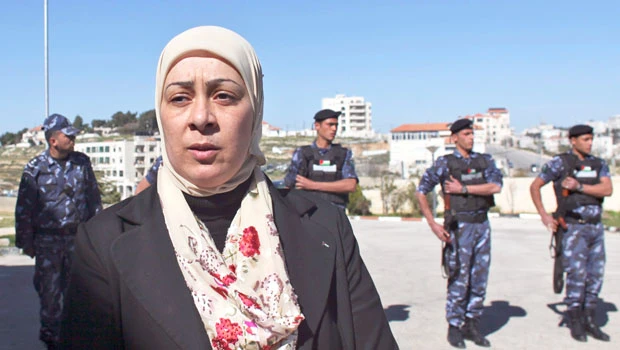
- RAMALLAH, West Bank: At 35, Leila Ghanem is the first woman to become a Palestinian governor, the latest in a group of trailblazing women leaders who are slowly winning acceptance in this traditional society.
Ghanem, a former intelligence agent, joins a cluster of women in senior positions in the West Bank district of Ramallah, a political and economic hub known for its relatively liberal social attitudes, where she was appointed governor earlier this year.
The mayor of the district’s main city is a woman, as are four ministers in the Palestinian Cabinet, two court judges and the head of a Palestinian financial oversight agency.
Ghanem is a woman of few words who is proud of her reputation as a no-nonsense official.
“There’ll be people who’ll say I’m pretending to be tough to prove herself,” Ghanem said. “But you have to be firm all the time — but you have to know when to be tough, and when to ease up.”
As governor, Ghanem’s role crisscrosses between ribbon cutting at project openings and resolving disputes between warring tribes. She also has a say over security matters, including President Mahmoud Abbas’ ongoing crackdown on his Hamas rivals.
Ghanem’s appointment as governor is part of a conscious effort by Abbas and his prime minister, Salam Fayyad, to promote women into senior positions, said Abbas aide Sabri Saidam. Still, equality remains a distant dream in the West Bank. Men dominate most senior positions and women only occupy 15 percent of the Palestinian work force. While they make up 55 percent of public servants, most hold junior positions in traditional professions like teaching and nursing.
Even so, the change in women’s opportunities from a generation ago is undeniable, said veteran Palestinian legislator Hanan Ashrawi, who for years was the lone female face in a crowd of male politicians. “Yet one more taboo has been broken,” said Ashrawi.
Ghanem runs a staff of 40, most of them men, and insists on being called “governor,” or “mohafez” in Arabic, not the feminine form of the title, “mohafeza.” She dresses in a modern Muslim style, in a pants suit and headscarf and prays five times a day.
In January, Abbas appointed Ghanem as governor of Ramallah, the most important of the West Bank’s 10 Palestinian administrative districts.
It’s a place where Palestinian women are clustered in senior positions. Janet Mikhail, a 65-year-old retired school principal, was elected Ramallah city mayor in 2005. Last year, Khuloud Faqih, 35, was one of two women judges appointed in the West Bank’s courts.
In Gaza, one woman, Jamila Shanti, occupies a senior position in Hamas’ decision-making body. They also have 6 female legislators and there are several women in senior municipal posts.
Still, Ghanem can rightfully claim a precedent as the first Palestinian female governor — and also the youngest person to be appointed.