
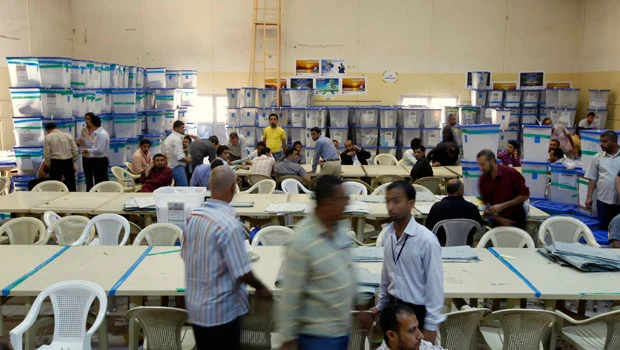
- BAGHDAD: The coalition of Shiite Prime Minister Nuri Al-Maliki held a wide lead on Saturday in early results from Baghdad, the major prize in elections Iraqis hope will stabilise a nation riven by years of sectarian warfare.
The Iraqi National Alliance (INA), a fellow Shiite bloc with close ties to Iran, trailed by 50,000 votes with just 18 percent of the count completed in Baghdad, worth twice as many seats in Iraq's next parliament as the next largest province.
The secularist, cross-sectarian Iraqiya list headed by former Prime Minister Iyad Allawi was a close third in Baghdad.
With early results representing only a fraction of the vote and no figures in from areas like the southern oil hub Basra, overall results were too close to call six days after the vote.
Politicians promised the parliamentary election would bring better governance and security as the United States prepares to end combat operations seven years after ousting Saddam Hussein.
But the margins tallied so far suggest weeks or months of horse-trading ahead to form a government and pick a prime minister. After the last elections in 2005, sectarian violence erupted as politicians took months to form a government.
Political analyst Hazem Al-Nuaimi cautioned against reading too much into Baghdad results because it was unclear which parts of the city, largely segregated along sectarian lines after the killing and flight unleashed in 2003, the early votes represent.
"It is clear that the final votes will be distributed among the blocs closely," Nuaimi said. "This means there will no winning bloc with a big margin." By Saturday, days after the Independent High Electoral Commission (IHEC) initially expected to report results, preliminary tallies from half of Iraq's 18 provinces were in.
Maliki's State of Law coalition led in five provinces, with the INA, a bloc including some former Maliki allies, ahead in one.
Allawi's Iraqiya was ahead by wide margins in two mainly Sunni provinces north of Baghdad, Diyala and Salahuddin, while powerful Kurdish parties led as expected in Arbil.
Even before a clear national picture had emerged, the political manoeuvring was under way.
Mindful that minority Kurds may prove kingmakers, Allawi held talks with Masoud Barzani, the leader of Iraqi Kurdistan.
"I came here to talk with the Kurdish leadership and with my brother the president. We share the same point of view for what should happen in Iraq regarding stability," Allawi said.
Lawmaker Hassan Al-Sunaid, a senior member of Maliki's Dawa Party, said the State of Law coalition was also talking with the Kurds and would hold discussions with other winning alliances.
"It is obvious that neither our bloc nor any other one will get the majority in this vote to form the government alone," he said. "But through alliances, a majority will be reached." Theories abound about possible alliances, based both on vote results and on chemistry between leading figures like Maliki and Allawi. It is still too early to say whose interests may align.
As IHEC struggles to fend off criticism about the delay in early results, it is also grappling with a new, complicated voting system, a slow computer grid, intense media scrutiny and even infighting among election officials.
No vote tallies had been released so far for Basra and Mosul, the most important population centers behind Baghdad.
In Baghdad, IHEC said Maliki's bloc won 158,763 votes, compared to 108,126 for INA and 104,810 for Iraqiya.
While the results from Baghdad lent some clarity to the political landscape after the March 7 vote for 325 parliamentary seats, allegations of fraud may yet scramble the picture.
Iraqiya has charged that ballots were dumped in the garbage, nearly a quarter of a million soldiers were denied voting rights and electoral commission workers fiddled with vote counts.
The election result is being watched closely in Washington.
The Obama administration plans to halve US troop strength in Iraq in the next few months, formally ending combat operations by Sept. 1 ahead of a full withdrawal by the end of 2011.
Continuity in a new Maliki-led government could be attractive to oil majors that signed multibillion-dollar contracts last year, part of Iraq's plan to challenge top oil producers within six years, but none of obvious candidates for the top job has suggested rescinding the contracts.