
- The rivets.
- They’re not right.” Jeremy Hall sighed resignedly, “Those rivets, they’re American.” He shook his head sadly at the enforced outrage with an air of professional resignation.
It was a movement honed to the point of an instinctive reaction by years of being presented with, as a UK customs officer, preposterous stories by nervous travelers who had been asked to open their suitcases.
Just fancy; American rivets on a Lancaster bomber he is in the process of restoring. The world had come to a pretty pass. We stood in companionable silence contemplating the offending rivets. They gleamed back at us smugly in the late afternoon sun at Brooklands Museum in Surrey.
The British do make singularly fine rivets. However, rivets seventy years old of the character and shape to match Hall’s meticulous restoration of the WWII bomber are not easy to come by. There are many old rivets in America. To suggest using modern British rivets would be to invite a basilisk stare from Hall that would freeze the life out of you. He must have been an exceedingly effective customs officer.
The British produce a distinguished line in eccentrics, the Brooklands Museum itself being the product of one, a motoring enthusiast Hugh Locke King. It is true to say that without the existence of Brooklands motor racing circuit, there would not have been a British racing presence which, over the decades, has contributed not just to the sport of auto racing, but to the development of automotive technology as we now take it for granted.
It is the genteel eccentricity of the museum that occupies some of the site of the original circuit however, that is so appealing. Even its foundation, which came about in the summer of 1906 at a particularly convivial dinner party Locke King held, was characteristically serendipitous. He “found” the story goes, after he had been told at a continental motor race meeting that British competitors stood no chance of winning anything, that he had volunteered to build at his own expense and on his own land the world’s first purpose-built motor-racing track.
With no motor racing experience to draw on the designer, one Colonel H.C.L. Holden of the Royal Artillery, used what he knew about — the principles and rules of horse-racing. The track itself incorporated banked curves and long and straight areas so that cars — or indeed horses — could be rigorously tested and achieve speeds well beyond road speeds.
The first official race opened on the £150,000 (SR 900,000) circuit on July 6, 1907 and was heralded by the motoring press as a ‘Motor Ascot’, a celebration of horsepower but without the horses. The world’s first 24 hour motor race took place there 11 days later and a couple of decades later the first and second British Grand Prix, founded by Henry Seagrave.
The rest is a rich 80-year history packed with names that have influenced not only the development of automobiles, engineering and racing but also the history of aviation. It even hosted the original “Chitty Chitty Bang Bang” — well, four of them in fact. Chitty 4 sported a 450 hp (340 kW) V12 27 liter Liberty aero engine with a gearbox and chain-drive from a pre-war Blitzen Benz, it was the largest capacity racing car ever to run at Brooklands.
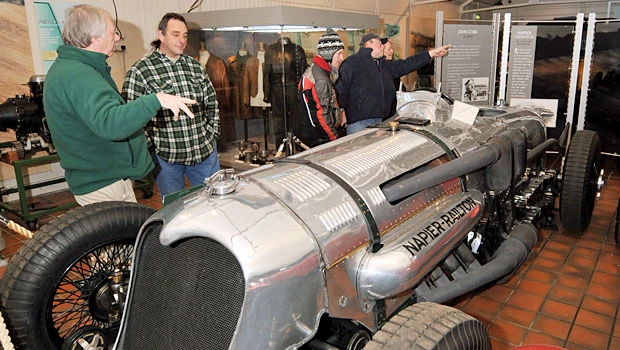
The heyday of the racing circuit was during the 1920s and 1930s when record times were being set and broken on a regular basis by Malcolm Campbell, John Cobb and others in such magnificently crafted machines as Napier, Delage, Panhard, Bentley and Bugatti. Some still sit in the small and friendly museum spaces. A magnificent polished aluminum Napier Railton — now there is a motoring legend — draws admiring, thoughtful observers. It still runs perfectly and is on occasions started and driven.
To the delight of generations of visitors, landspeed record holder Malcom Campell’s workshop and original shop is still there.
Aviation played a seminal role in the development of Brooklands. 1908 saw the first taxiing and towed flight trials of a British full-size powered aircraft by a British pilot, Alliott Verdon-Roe- founder of Avro — as in Avro Lancaster bomber. During World War I, Brooklands closed to motor racing and was requisitioned by the War Office. Vickers Aviation Ltd. set up a factory in 1915, and Brooklands soon became a major center for the construction, testing and supply of military airplanes.
Motor racing resumed in 1920 but when WWII broke out in 1939, motor racing ceased and the site was again used for military aircraft production, in particular the Vickers Wellington, Vickers Warwick and Hawker Hurricane.
After the hostilities, racing never returned to Brooklands. It was sold to Vickers-Armstrong in 1946 for use as an aircraft factory. New aircraft types including the Viking, Viscount, Vanguard and VC10 were manufactured and delivered from there.
Vickers was absorbed by the British Aircraft Corporation in 1960 and went on to design and build the BAC TSR.2, One-Eleven and major parts for Concorde. One of the last is parked there; you can sit in it and even have lunch in it.
The factory contracted in size in the mid-1970s, became part of the British Aerospace in 1977 and finally closed in 1988-89.
On one cold, bright December 2009 day, the museum, founded in 1987 and dedicated to the preservation of aviation and motoring heritage, opened its doors to pre-1973 cars to drive in and share the living heritage of world motors car history with the public. It relies heavily on voluntary curators — many retired professionals for example accountants, pilots and civil servants — who have a deep love of and respect for the exhibits. Ask a question of one and within a few moments several will gather round with an encyclopaedic store of specialist knowledge on offer, keen to share. These are genuine enthusiasts, sober solid souls who care very much about their charges.
Hence the rivets.
Jeremy Hall would not for a single moment describe himself as an eccentric. Frankly nor would I; he is a man with a fine sense of history who recognizes its value and the need for accuracy and precision in recording it. Wrong rivets equals wrong record.
He had arrived for the day in a beautifully restored wartime Jeep — complete with all the accessories down to water bottle and pencil — to show the visitors his Lancaster. It was ironic, seeing the partly restored legend on the site where the company built it was conceived by AV Roe nearly a century ago — and Hall not able to get a proper British rivet.
The moment that brought the value of keeping that history faithfully recorded and alive for future generations to even begin to understand what went on came when I climbed into the belly of the partially restored bomber. It was notorious for a wing-spar that blocked most of the fuselage between bomb doors and cockpit. How, I wondered, did the pilot, navigator and radio operator get past this and out in a hurry if shot down?
Often these very young airmen just didn’t. Jeremy Hall instinctively understands this. For the sake of historical accuracy, an unvoiced respect for all the builders, flyers and combatants of all sides, for all these reasons he tries to get the reconstruction of their fragile war machines right.
Damn rivets.