
- The line of duty calls, it is 5:30 a.m., and here I am on the highway to Dammam for a meeting with Sri Lankan expatriates as the newly arrived ambassador.
- The occasion: celebrating Sri Lanka’s Independence Day at which I am chief guest
The sun, like a fiercely giant orange ball, is rising steadily to my right; its rays throwing up flashes of crimson on a grayish blue-sky overhead. We pass gas stations with bright green lights that sparkle.
Suddenly, we receive a telephone call — a warning of poor visibility ahead. We soon reach dense fog. The car slows down from high speed to a crawl and ahead of us hazard lights blink. The sun is nowhere to be seen and visibility is down to a few meters all round. Many drivers pull aside and stop; so do we.
We wait and then start as the sun reappears just in silhouette. The driver obviously sees more into the fog than I. The car picks up speed and registers 70 km. Apprehensive of some real or imagined danger lurking ahead, I busy myself into reading “Woolf in Ceylon” by one time Sri Lankan Christopher Ondaatje.
Curiously, I am at the point of reading Leonard Woolf’s perilous journey in 1905 from the ancient city of Anuradhapura to Elephant Pass in Northern Sri Lanka, a journey through arid countryside, the closest comparison to the desert I was traveling.
But curiosity of what was happening around makes concentrating a near impossibility. I begin to munch breakfast in addition to reading. The double distraction appears to work. I imagine how hardy Arab travelers of yore traversed this desert so long ago. Do I see an apparition or two lurking in the distant haze?
The fog is utterly blinding and nothing can be seen beyond a few meters. There is a pulsating sense of claustrophobia. A car appears suddenly from behind and then vanishes into the uncertain terrain ahead, but the haze hangs on grimly.
The driver steps on the gas and the car is cruising at 120 km. The sun comes into gradual view along with the outer wall of a farm. The heartbeat goes down to normal! More forms of human habitation are visible — neatly trimmed trees, electricity pylons, telegraph poles and passing cars.
As fast as it appeared, the sun is consumed once more by thick fog. Even in the stillness of the desert things change fast. The hazard lights twinkle in the haze again. The car’s sensors bring to life the wiper blades wiping away the dew. But this time nature cannot stop us, we must be on time for the meeting. The speed of the car increases and so does the heart beat but with much less intensity. But the driver is casually confident and bites into his breakfast only to swerve suddenly into the next lane — a car ahead noticed just in the nick of time.
The giant red ball in the sky appears once more. The haze is nowhere to be seen and the empty desert gives way to a sudden burst of planned green and modern buildings. We have arrived in Dammam. The journey of 389 kilometers is complete. The skyline has been utterly transformed with facades of great architectural and esthetic beauty staring at both stranger and town folk alike.
The meeting over with, we head back to Riyadh. It is just past noon and the sun is blazing away in all its glory. The sands have turned into a fierce, yellowish red with some occasional green growing here and there. The desert has claimed a Cadillac, which stands half buried on its axel sans tires and glass. Readings from Shelley’s “Ozymandias” learnt so long ago in the college classroom waft into the mind for there are many more victims of steel lying along the way.
“Two vast and trunkless legs of stone
Stand in the desert ... near them, on the sand
Half sunk, a shattered visage lies…”
A lone tree all of two feet stands sentinel, as if to remind me, a child from a greener, herbaceous isle, that nature exists even in this place. Such are the strange ways of the desert. Hundreds of insects lie still on the windscreen loudly proclaiming that wings do flap and hearts do beat out there. The desert has formed its own little dunes of sand in a myriad of artistic forms shaped by the wind. We are now passing through the fringes of the Ruba’a Al-Khali or the “Empty Quarter,” the sands of which lay over a quarter of the Arabian Peninsular. It is reputedly the hottest place on earth with summer temperatures soaring over 61?Celsius — in the shade! What if the car breaks down, I wonder.
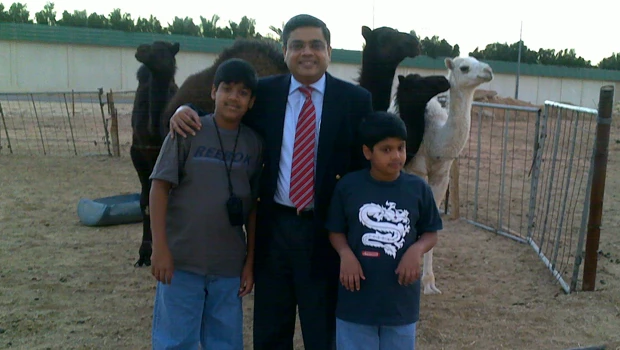
A herd of single humped camels in hues of black, brown and white graze somewhat close to the road. Are they eating some green or simply the sand, my eyes strain to detect and mind yearns to know. The shepherd is nowhere in sight and the ships of the desert carry on nonchalantly.
The car is now hurtling toward Riyadh, its six cylinders pounding away quietly under the bonnet. But the layer of tar is smooth as silk and there is hardly a ripple in the bottle of water nestling in its receptacle in front of me. The road ahead is straight as far as the eye can see, like a single line drawn on a clear sheet of paper, for there is nothing but wilderness on both sides and the road is the only reminder of human presence. The rest belong to nature.
I look to my right and a dust storm gathers in the distance bringing to mind crooner Jim Reeves’ lines from the “Blizzard.” I look at the radio but it is not on. “I guess we should be moving faster if we can.”
Fatigue seems to be creeping slowly and it is time for the involuntary forty winks. A slight jolt and I awaken thinking it is Riyadh, but it is not so.
Traveling the desert has brought a bounty of experience — its richness, its color, its mystery, its eternal beauty and a feeling of the enormous forces of nature silently at work. The sun, the shifting sands and the sky are its protagonists and everything else around seems to pale into insignificance.
In these parts, the desert is indeed central to the eternal cycle of human existence. And so whether living in it, traversing it, indulging in some sand dune racing for fun, simply sitting it out in the evening on a carpet, or enjoying a barbeque on a moon lit night, these people have accepted with excellent grace the desert and all that is contained within it.
There is beauty and life pulsating out here, I tell myself before going gently into the goodnight, with a rich trawl of memories gathered during my eight hours out there in Camelot. Yes, the mighty desert has indeed claimed another ardent admirer!
-- The author is the ambassador for Sri Lanka in Saudi Arabia