
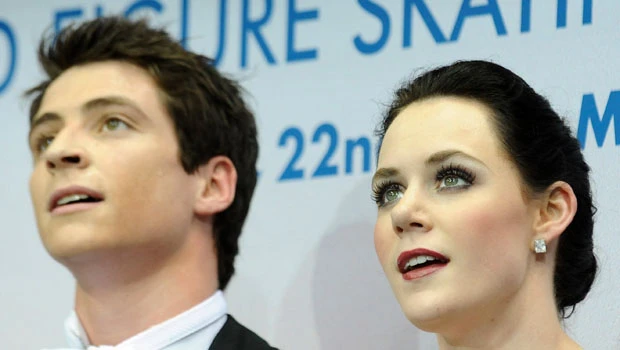
- TURIN, Italy: Olympic champions Tessa Virtue and Scott Moir led what might be the last compulsory segment in ice dance at the world figure skating championships on Tuesday.
The Canadian pair scored 44.13 points, ahead of training partners and Vancouver silver medalists Meryl Davis and Charlie White of the United States with 43.25. Federica Faiella and Massimo Scali of Italy were third with 40.85.
The International Skating Union congress will vote in June on a proposal to eliminate compulsories, leaving just two components and two days for the event: Original dance and free dance.
The compulsory dance, where couples perform the same steps to the same music, is a TV ratings killer and hardly a spectator draw. But the event also develops the basic skill set that helps distinguish the discipline: Deep edges, speed, stroking, skating in unison.
Virtue and Moir and Davis and White are the vanguard of ice dance, a new generation that has proven its mastery of the compulsory and seeks to reshape the discipline into something more dynamic. But an event where 27 couples dance the same steps for 2 minutes, 10 seconds spread out over an entire afternoon does not do that, they say.
“I don't think it is necessary any more in today's sport of ice dance. I think it has come a long way and it is holding it back,” Moir said, adding with a laugh, “That's our opinion, but what do I know, I am only Olympic champion?” Virtue said they spend up to two hours a day on compulsories, which both she and Moir believe was not value for time considering compulsory's worth in the overall score.
“I can't imagine what we could do with our OD and free program if we had that extra time,” Virtue said.
Davis and White, who train with the Canadians, agreed.
White gave a whoop of joy at the idea that the compulsory could be abolished.
“We believe it is not really taking dance in the direction most people are trying to take it right now,” Davis said. “We have always been trying to put athletics in the sport.” But there are other skaters, including Italy's Scali, who believe the compulsories are the foundation of ice dance and are reluctant to see them go - certainly at a junior level if not at seniors.
Americans Emily Samuelson and Evan Bates fall into that camp. “You can't call it ice dance” if there are no compulsories, Bates said. “It really is a shame. The compulsory is the one thing that is less subjective with ice dance.” Later Tuesday was the pairs short program.
Aliona Savchenko and Robin Szolkowy of Germany, whose dream of Olympic gold fell to Chinese competitors, face formidable Chinese competition again as they seek to defend their pairs title. Olympic champions Shen Xue and Zhao Hongbo are absent, but silver medalists Pang Qing and Tong Jian are present along with Zhang Dan and Zhang Hao, who placed fifth at Vancouver.