
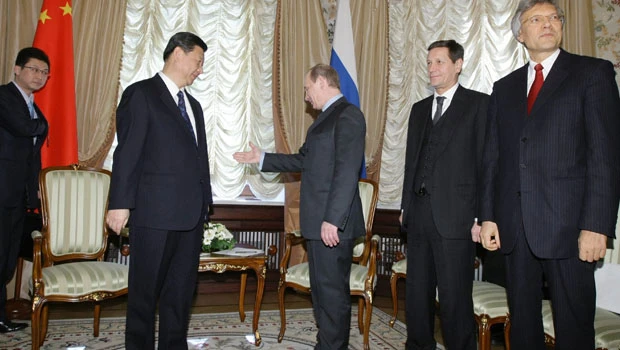
- MOSCOW: The man widely seen as China's next leader told Russian Prime Minister Vladimir Putin on Tuesday the world's two most powerful emerging market economies should help each other increase their weight in global affairs.
China and Russia say their trade and political relations are better than ever, though senior Russian officials are privately concerned about an increasingly assertive China along Moscow's vast and largely empty southeastern border.
Vice President Xi Jinping, seen as the frontrunner to succeed President Hu Jintao in 2013, told Putin Beijing wanted the power of key developing nations to be recognized.
"We consider that in the process of the deep transformation of the world order, the interests of China, Russia and other developing countries must be taken fully into account," Xi said.
"Russia and China must become strategic props for each other in the future on all questions which have a strategic interest for Russia," he told Putin at the start of talks in Moscow.
Analysts said the visit to Russia - which will include a meeting on Wednesday with President Dmitry Medvedev - was aimed to acquaint Russia's leaders with a potential successor to Hu.
"Xi Jinping is considered to be one of the candidates to replace Hu Jintao so it is a very important visit, to get acquainted with him and to understand the aims of the man who could be the next ruler of China," said Fyodor Lukyanov, editor of the magazine Russia in Global Affairs.
Russia has called for the group of emerging market powers known as BRIC - which also includes Brazil, India and China - to be given more say in world affairs, though China's economy is bigger than the other three put together.
China, the world's fastest growing major economy, has in recent years sought to secure long-term oil and gas supplies from Russia, the world's biggest energy producer, which has been battered by the economic crisis.
China's economy grew by about 8.5 percent to $4.76 trillion last year while Russia's economy shrank 7.5 percent to $1.25 trillion after a 10-year economic boom, according to the International Monetary Fund.
Russia is a keen buyer of Chinese manufactured goods, though Moscow is worried that its former Soviet role as a supplier of technology and arms to Beijing has largely vanished as China's own industries overtake Russia's.
Russia also sees China as an important partner in efforts to limit the influence of the United States on issues ranging from Iran's nuclear program to reducing reliance on the dollar.
"We have always supported China on the most sensitive questions, including on the problem of Taiwan," Putin said. Xi said Russia and China should work to prevent the dominance of a single power, shorthand for US influence.
Xi's talks in Moscow will include discussions about trade, investment, energy and the development of the sparsely populated regions of Russia's Far East, Russian officials said.
But behind the warm phrases of support for closer ties, many Russian policy makers are increasingly anxious about China's rise as a world economic and political power.
"The growing economic imbalance - China has already overtaken Russia on all parameters - cannot but provoke concern, even if China tries to demonstrate its benevolence," said Lukyanov.
China was Russia's second most important trade partner last year after the European Union, though bilateral trade tumbled 29 percent to $39.5 billion from $55.9 billion in 2008, according to Russian customs statistics.
Bilateral trade fell as the economic crisis undermined demand for metals, oil and gas, Russia's main exports, but this is expected to recover this year.