
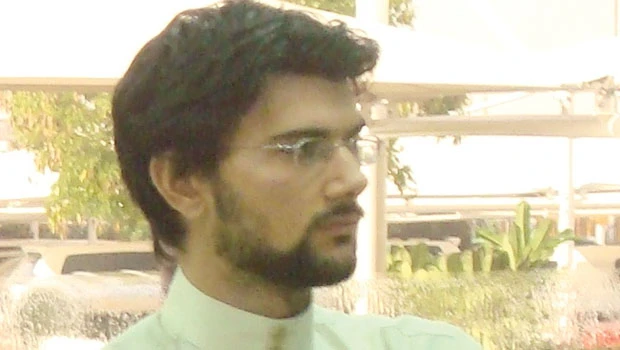
- The End of the Fall” by 28-year-old Saudi Mostafa Fahmi, tells the story of a chain of fictional events with nonstop suspense and adventure.
- It is a fantasy novel in English for the youth.
Greek, Roman and Japanese mythologies are reflected in the story, which also carries a twist of Arabic culture due to the Arabian characters.
The novel tells the story of a young boy who falls down a well, only to discover that it is a portal into another world.
“Lord of the Rings, Chronicles of Narnia, Harry Potter. All are legendary novels loved by millions, even the youth in the Arab world. But how do we truly relate to them? That is what drove me to write my story. We got these novels to love and enjoy, but we have our culture to relate to,” he said.
“My goal was to make this story a page turner. With a big beginning and an even bigger finale, each chapter has its own events which are connected to each other.”
Fahmi started writing “The End of the Fall” when he was eight-year-old, inspired by a water well that he saw in England. He wrote the beginning of the story for a school project. “The story was simple, told from a perspective of an eight-year-old boy,” he said.
Fahmi abandoned his story until he turned 20. He then realized that he should give it another chance using the perspective of a mature man.
His life experiences, his dreams and the people around him inspired him and that is demonstrated in various events in the story. He named the protagonist after his brother Majid, and he dedicated a whole chapter to the 2006 war in Lebanon, which he witnessed firsthand.
“Silence returned to the city, but this time, it was something far greater than a thousand soldiers coming into the scene. This time the city shook greatly, and the stones started to crumble to what seemed like an earthquake, it certainly wasn’t a work of nature that shook the dark silent streets,” Fahmi writes in the chapter “Siren”.
“The ground of the lonely city opened like a gate to create a hole cutting the city in half, and from beneath the city, a tremendous amount of fire came up and lit the dark sky to burn the whole front line of the army, and those who managed to avoid the fire or be caught by it had all scattered and retreated in uttermost panic. And it was then when that thing elevated swiftly from under the city. It was worth the panic, but does anyone deserve to experience this level of fright?”
In the beginning Fahmi treated the story as a personal project. But after sharing it with a number of people he decided to go public with it.
“I think maybe deep inside I didn’t believe it would be appreciated, but the few people who read it encouraged me to try and publish it,” he said.
That is when he was faced with dismissive publishing houses. In 2007 Fahmi sent a manuscript of the story to several publishing houses.
“I was looking for someone who would adopt the novel and invest in it, but my approaches were met with dismissal,” he said.
“A certain response stated that the style of my story has no audience in the Kingdom since Saudis don’t read. I felt this statement was a sad excuse for a rejection. Because reading is not a product to have an audience, reading should be treated as a mandatory aspect of any civilization’s development.”
As a last resort, Fahmi shared his story on the Web and that is where a fan base started to develop, proving to him that there was an audience who would understand and appreciate his work.
“This novel has its spectacular settings, events and characters. It is a lovely fantasy combined with real life characters that are a reflection of our thoughts and actions,” said one of them on his website.
“I loved the writer’s imagination, it seemed like a dream and it felt unreal. I also love how I could relate it to our culture, as the writer is very descriptive. He gave me a clear picture of everything,” said another.
As for now, he again has neglected publishing the story and is focusing on his job and career.
“The support I received from the online readers has given me a personal boost of confidence and it made me believe that the story will be on the shelves of bookstores one day.”