- PRAGUE: The United States and Russia signed a landmark strategic nuclear disarmament treaty on Thursday and said new sanctions may be necessary to put pressure on Iran to renounce its nuclear ambitions.
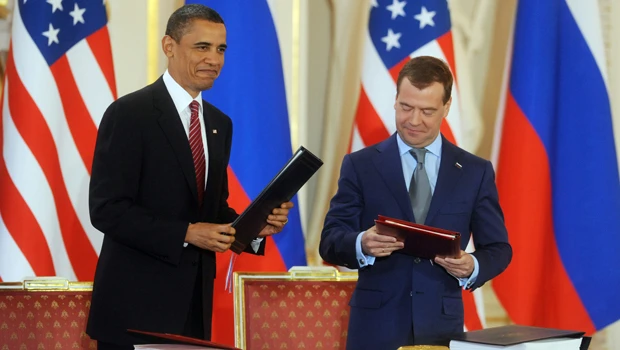
Presidents Barack Obama and Dmitry Medvedev signed the pact at a ceremony in the mediaeval Prague Castle after talks that covered nuclear security, Iran’s atomic program and an uprising in Kyrgyzstan.
The treaty will cut strategic nuclear arsenals deployed by the former Cold War foes by 30 percent within seven years, but leave each with enough to destroy the other.
Obama said the agreement had “ended the drift” in relations between Moscow and Washington and sent a strong signal that the two powers that together possess 90 percent of all atomic weapons were taking their disarmament obligations seriously. “We are working together at the United Nations Security Council to pass strong sanctions on Iran and we will not tolerate actions that flout the NPT,” he said, referring to the Nuclear Non-Proliferation Treaty.
“My expectation is that we are going to be able to secure strong, tough sanctions on Iran this Spring,” he added.
Medvedev said he regretted Tehran had not reacted to constructive proposals on its nuclear program and the Security Council might have to take further sanctions, but they should be “smart” and not bring disaster on the Iranian people.
“Today we had a very open, frank and straightfoward discussion of what can be done and cannot be done,” the Russian president said, adding he gave Obama a list of Moscow’s limits.
Russian Deputy Foreign Minister Sergei Ryabkov declined to detail the list but told reporters a total embargo on deliveries of refined oil products to Iran, for example, would be unacceptable since it would cause a “huge shock for the whole society and the whole population.”
The situation in Kyrgyzstan, where opposition protesters forced out President Kurmanbek Bakiyev on Wednesday, thrust its way on to the agenda as both Washington and Moscow have military bases in the poor Central Asian state. The US base at Manas is vital for supplying NATO forces in Afghanistan.
The US president reaffirmed the long-term goal he set in a speech at the same Prague Castle a year ago to work toward a world without nuclear weapons and said Medvedev would visit the United States later this year to discuss further cooperation, including withdrawing short-range tactical nuclear weapons.
Both men said they hoped and expected the new treaty would be ratified this year.
Medvedev, mindful of past problems in winning approval in the treaty-shy US Senate, said the ratification process should “proceed simultaneously.”