- KHARTOUM: With lines of voters hunkered down for hours on makeshift benches or sheltering under trees from the baking sun, Sudan’s complex and controversial elections got off to an often chaotic start.
Officials had spent months preparing for the polls, but confusion erupted on Sunday as center after center, sometimes hours into the voting, discovered that voters were using the wrong ballot papers or that names or symbols of candidates were either missing or incorrect.
Given that votes are being cast for two presidents, 24 governors and 26 state and national assemblies, using three different voting systems and up to 12 ballots, things were bound to go awry.
Many opposition parties boycotted the elections, citing widespread fraud before the voting even began. The National Elections Commission had insisted it was ready, despite demands from the opposition for a short delay to ensure the process ran smoothly. Mokhtar Al-Asam, a top official, said on the eve of voting that the electoral system was “foolproof.”
It was a novel experience for many voters, and for election officials. Some were too nervous to ask voters to dip their fingers fully into indelible green ink — used to show that people had cast their votes — and had to be reminded of the rules. Quite which ballot papers to use also posed a problem for some election officials.
“We’re running out of ballots,” one shouted down the phone, urging Sudanese observers not to worry — until he discovered the parliamentary ballots he had been using for the past four hours were from a different constituency and voting was halted. That center was brimming with policemen, who had waited for almost four hours to vote. Their presence worried some of the monitors. Other centers had line after line of soldiers pushing to get in the door.
“There’s only one national party in this country — the National Congress Party,” one of a group of soldiers, sitting in the army lorry, which had brought them to vote, said in reference to President Omar Bashir’s party.
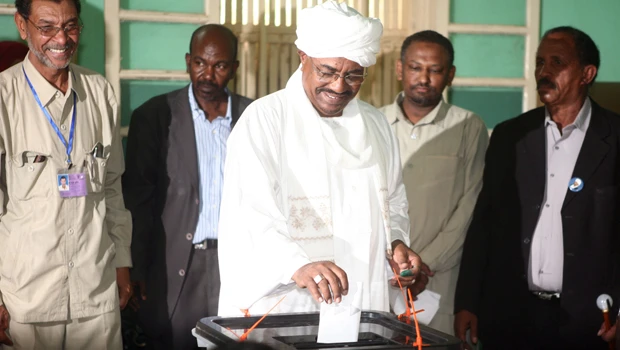
Voting booths were made of cardboard and many were already looking ragged on the first of three days of polls. Ill-trained local monitors watched carefully but few noticed basic errors such as the use of incorrect ballots. Voting was a difficult task even for those with a seasoned political eye — it took Bashir 10 minutes to cast votes on his eight ballots. The confused scenes in some stations in Khartoum prompted many to wonder what was happening in the more remote parts of Africa’s largest country, where illiteracy rates are high and decades of civil war has devastated infrastructure. Despite the problems, many Sudanese insisted on voting. After a quarter-century without free elections, they saw the event alone as historic, despite the boycotts and complaints.