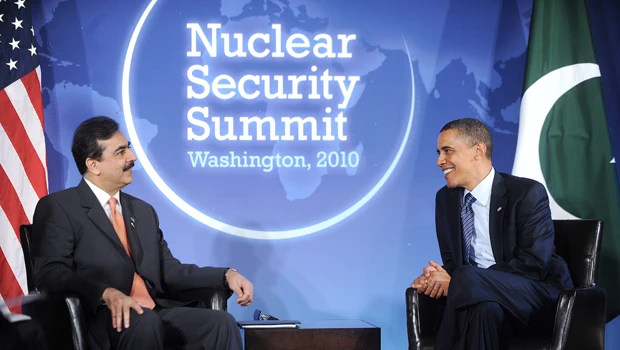
- WASHINGTON: The nuclear security summit President Obama opened on Monday underscores the president’s ambition to spotlight the global task of securing nuclear materials and keeping them out of the hands of extremists and terrorist organizations.
The two-day conference in Washington is the largest gathering of world leaders hosted by the US in more than six decades when President Franklin D. Roosevelt organized a meeting in San Francisco in 1945 that created the United Nations.
Obama’s aim is to enlist other nations to help secure all loose nuclear materials — which could cause harm if they fell into the hands of terrorists — within four years.
But for all its symbolism and ceremony, the conference has limited goals: seeking ways to secure existing supplies of bomb-usable plutonium and highly enriched uranium.
Obama welcomed the assembled world leaders at a Washington convention center late Monday afternoon, but began the day with a morning meeting with Jordan’s King Abdallah.
He also held one-on-one meetings Monday with the leaders of Malaysia, Ukraine, Armenia and China.
On Sunday, Obama held a series of pre-summit, one-on-one meetings with the leaders of India and Pakistan, nuclear-armed neighbors, as well as from Kazakhstan and South Africa, two countries he said have helped in the effort to restrain the spread of nuclear weapons.
North Korea, Syria and Iran, much criticized by the West for their suspected nuclear agendas, were not invited to the summit.
Also likely to come up at the summit this week is the last-minute decision by Israeli Prime Minister Benjamin Netanyahu to cancel his plans to attend.
Netanyahu sent the country’s atomic energy minister instead, because of concerns that his country’s undeclared nuclear weapons program would become a central topic.
Israel has quietly supplanted Britain as the world’s fifth largest nuclear power, and now rivals France and China in terms of the size of its nuclear arsenal.
While much attention has recently been lavished on the potential threat posed by Iranian weapons of mass destruction, the major nuclear power in the region, Israel, has been largely ignored.
Turkey’s Prime Minister Recep Tayyip Erdogan said Sunday the world is turning a blind eye to Israel’s nuclear program, and he vowed to raise the issue.
The historic, two-day gathering of leaders from 47 countries is not expected to result in any major strategy changes or declarations, but it is meant to show Obama’s eagerness to lead on the issue, administration officials say.
By Tuesday evening, when the conference closes, Obama wants to have reached agreement on a plan to secure the world’s stockpiles of plutonium and highly-enriched uranium (HEU) – essential ingredients in the building of nuclear weapons.
But critics say the agreement frees up older facilities that India can devote to making its own new generation of weapons, escalating the arms race between India and Pakistan — even as Obama and President Dmitri Medvedev of Russia sign accords to shrink arsenals built during the Cold War.
“If I were advising President Obama, I’d say you have to be prepared for some trade-offs with countries that don’t place the same priority on this issue that you do,” Charles Ferguson, president of the Federation of Atomic Scientists in Washington, told reporters.
Securing loose nukes and keeping dangerous materials out of the hands of dangerous nonstate actors may be a legitimate priority, but achieving the goal will be more difficult if developing countries in particular get the sense that they are losing out and paying a price for the developed world’s security, he said.