
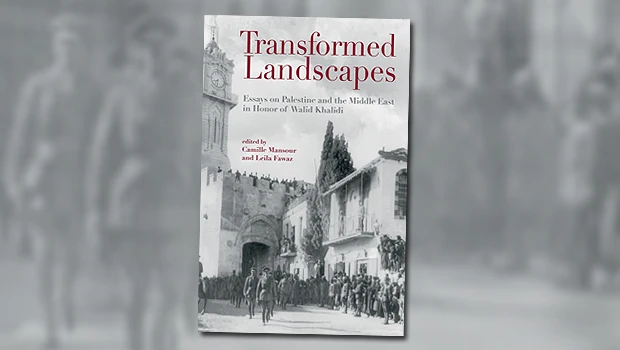
- These essays are dedicated to Walid Khalidi — one of the most influential Palestinian intellectuals of the second — half of the twentieth century.
An eminent scholar, he joined Oxford University in 1951 as a university lecturer of Islam. He resigned five years later, however, in protest over Britain’s involvement in the tripartite invasion of Egypt. He then taught successively at the American University of Beirut, Harvard University and the University of Cambridge, where he remained until his retirement.
Khalidi was a driving force behind the creation of Arab research institutions, especially the Institute for Palestine studies. Furthermore, he was involved in Palestinian politics and Arab diplomacy. In the mid-1980s, for example, he was appointed as the special adviser to the secretary-general of the Arab League.
Most of the time, however, he officiated behind the scenes. His good relations with leaders of Palestinian factions, leading politicians in Lebanon and Egypt, the Jordanian monarchy and key figures in a number of Arab countries enabled him to come up with solutions in a number of situations such as: The continual Jordanian-Palestinian tensions, Lebanese civil war and internal Palestinian disputes. In 1991, he served as a member of the Jordanian-Palestinian joint delegation to the 1991 Madrid Peace Conference and the first two subsequent rounds of bilateral negotiations with Israel in Washington, DC.
In Transformed Landscapes, colleagues, friends and former students wrote about subjects related to Khalidi’s academic interests. Their contributions — gathered into four main sections — reflect the changes that occurred in the 20th century Middle East.
The first section contains three essays that acquaint us with the lives of three Arab personalities whose ideas and actions foreshadowed the struggles of our time (just like Abd Al-Ghani Al-Nabulsi’s writings anticipated Arab nationalism). The authors of the second section of essays challenge traditional views of the Arab East whereas the authors of the third section describe a period following the aftermath of the war in Palestine. The fourth and final section presents essays that connect the Middle East to the international arena. It also features one of the most interesting topics in the book, namely, “America’s: ‘Palestine Fatigue.’” Since the collapse of the Soviet Union, the United States has become the most powerful and influential country in the world. The author, Michael Hudson, tries to understand why the American Public and much of the political establishment are bored with the Palestinian conflict.
The Bush Administration’s decision to set aside the Palestine issue froze American diplomatic efforts for six years. This political inaction has been unfortunately coupled with a flurry of negative presentation of the conflict defying any solution.
As Michael Hudson writes:
“Nothing could be more conducive to ‘Palestine fatigue’ than an intellectual assessment that the matter is hopeless… An alarming campaign has been under way for many years to intimidate and suppress scholars deemed by pro-Israeli militants to be ‘anti-Israeli’ if not anti-Semitic. Pressures have been brought to bear on university administrations to curb alleged pro-Palestinian professors. Blacklists have been created and campaigns have been waged against specific scholars at prestigious universities such as Columbia.”
The Jewish lobby is also very active in the political arena. It offers attractive incentives to politicians seeking reelection if they support pro-Israel policies and undermines politicians who favor a more even-handed American stance. The Arab and Palestinian lobbies are nowhere as powerful as the Jewish lobby and the business community is still reluctant to criticize the pro-Israel lobbies.
However, in the face of Europe growing influence in world affairs and the rise of Asian powers such as India and China, the US might be induced to adopt a more multilateral approach toward Israel and Palestine.
Hudson suggests that public opinion should play a more active role, and Arab-Americans should strengthen their efforts to communicate with politicians. Furthermore, pro-Palestinian think tanks should be more creative in proposing viable diplomatic and political strategies:
“It is one thing to criticize America’s lamentable ‘Palestinian fatigue,” but something else and better to offer constructive new thinking. For example, a Palestinian Marshall Plan? Tedious as it may now appear, the Palestinian issue remains the root of deep tensions rolling across the entire Middle East and the Islamic world. It is too important to ignore.”
Khalidi devoted his life to the Palestinian cause, often at the expense of his academic work. He was continuously torn between the urge to analyze and explain the tragedy of the Palestinian people and the desire to try and do something in the present. These essays written by an outstanding group of international scholars remind us of Khalidi’s remarkable legacy.
Book info: