
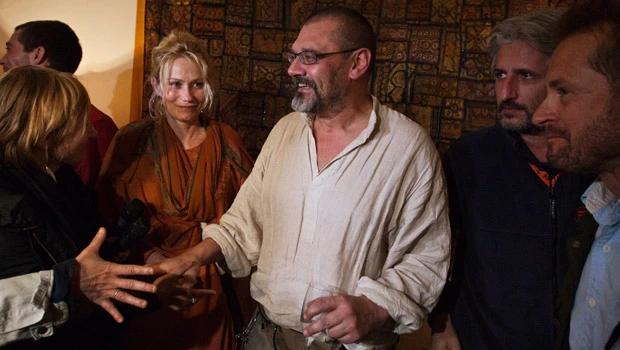
- KABUL: Three Italian aid workers arrested a week ago in Afghanistan were freed on Sunday and are in good condition, the United Nations and the Italian government said.
The three were detained on suspicion of plotting to kill a provincial governor but have now been declared not guilty by Afghanistan's intelligence agency.
"They are in very good condition. It is over," the top UN envoy in Afghanistan, Staffan de Mistura, told reporters outside the Italian embassy in Kabul after visiting the Italians inside.
In a statement on Sunday, Afghanistan's National Directorate of Security said its investigation showed the three Italians were "not guilty" and "had been handed over to the Italian authorities.”
Italian Foreign Minister Franco Frattini announced their release in Rome and expressed his gratitude for the swift resolution of the issue, after Italy had pressed Afghan authorities to either present charges against the charity workers or release them.
The members of the Italian medical charity Emergency were detained on April 10 in the violence-torn Helmand province and accused of taking part in a scheme to assasinate the governor, Gulab Mangal.
"We obtained our primary objective which was the freedom of our compatriots without undermining our firm solidarity with Afghan institutions and the international coalition," Frattini said in a statement.
Italy has more than 3,000 troops taking part in the NATO-led mission in support of President Hamid Karzai's government against the Taleban insurgency.
Karzai met Attilio Iannucci, Italy's special envoy to Afghanistan and Pakistan on Saturday to discuss the case.
The three aid workers - Marco Garatti, Matteo Dell'Aira, and Matteo Pagani - were taken to the Italian embassy in Kabul after being released.
Emergency - which has operated hospitals and health clinics across some of the most dangerous parts of Afghanistan even under Taleban rule before 2001 - has a high profile in Italy and the case shocked public opinion there.
They were arrested last weekend in Lashkar Gah, capital of Afghanistan's most violent province, where their hospital is one of the few independent aid organizations.
As in many other NATO countries, Italy's role in the war is a polarising domestic political issue, and the popularity of the mission has been strained in recent months by doubts over whether Karzai's government is a reliable ally.