
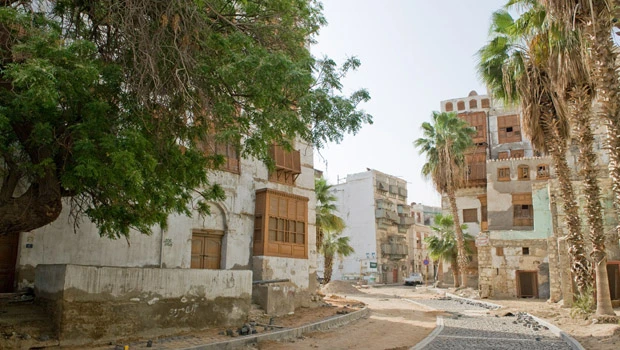
- JEDDAH: The northern end of the Balad is in the throes of a makeover, as a restoration plan gets under way to smarten up Jeddah’s historic old town.
The tarmac on the first of the cramped streets has been ripped up and piled ready for removal and the first of the new cobbles laid in a process of simultaneously restoring the character and upgrading the quality of the district.
There is still much to be done, but the first restoration steps have been taken. It is a good time to visit, especially early on a Friday morning when most of the inhabitants are in bed.
The cars and vans that normally clutter the place are temporarily gone and the scene is visually miraculous. Without the vehicles blocking the streets, pedestrians are free to roam unhindered and the place takes on a new feeling of space and scale.
What was once a cross between a car park and a junkyard has revealed itself as having a pleasant open character-filled urban environment to stroll through.
Small squares and shady trees with occasional wandering pedestrians give the place its sense of scale. Pervading the place is a silence that cannot have been there since the cars and trucks of traders first came along decades ago.
Stripping away the vehicles has also revealed what they largely concealed. The decay of the buildings is exposed; entrances to cramped buildings that were once secured by intricately carved wooden doors are eyeless sockets in the crumbling coral faces of two-century old houses.
Sometimes they have been replaced by crudely made sheet metal doors that are the triumph of function over form.
Intricate carved gypsum stucco is still visible around crumbling doors and windows, and the roshan — the wooden shutters — on buildings are in a worse state than ever. Pieces frequently fall from the older ones and the debris can be seen in the streets.
There have recently been fires in some of the buildings in the Balad, gutting rooms and weakening the fragile structures even more than what the ravages of time and commerce have done. The usual excuse, met with a cynical raised eyebrow by many as rote rather than established fact, trotted out by the Fire Department for the cause of a blaze is “faulty electrical wiring.”
A short stroll through the cramped alleys immediately shows how easily the Fire Department could be correct.
Skeins of random wiring hang like untidy cobwebs from buildings and, like cobwebs in the morning dew, are dotted with drops of water. The water comes from the ancient air-conditioning units perched perilously above, dripping water onto cables and wires that lead to junction boxes open to the elements.
Water and electricity are never good bedfellows. Open-ended live cables are secured by pieces of twisted wire — probably with every intention of a temporary fix — to metal pipes.
The dust and grime of ages shows that the temporary has become permanent and the danger it represents has slowly been forgotten by generations of transient locals. It is, however, still there and easily could spark and become the cause of one more Balad fire.
Much work and some very tough decisions by the Jeddah city Mayoralty, private families who own buildings and others have to be taken on the future of the Balad, not the least of which being what to do with the population and illegal warehousing the buildings are often used for. It has almost become a race; will it burn down before it falls down?
Work seems to be under way and something is being done. The effect on the face of the old city of even this minimal amount of effort is remarkable. There is an enormous amount to do yet, but every journey begins with a single step and one has at last been taken.