- JEDDAH: Water and wastewater projects costing SR10 billion have been launched over the last two years although the majority of them are yet to be completed.
- Four-fifths of the funding had been allocated for projects in Jeddah alone.
The CEO of the National Water Company (NWC) confirmed the figures to the local Arabic media in response to growing public concern about wastewater disposal in Jeddah following the devastating floods last November. Loay Mussallam added that there were currently companies from Turkey, Korea, the United Arab Emirates and the Kingdom working on the projects and that the NWC was coordinating with them to finish the work quickly.
The disclosures have, however, led to unconvinced local residents asking where the money has been spent and when the projects will be finished.
“Whenever I hear that the city municipality or a related company is dong this or that to solve the sewage problem, I just dismiss it as empty promises,” said one Jeddah resident who simply gave his name as Mazen.
“The newspapers always report that money has been allocated but where does the money truly go?”
With 2.5 million people living in Jeddah and summer coming up, a solution to the sewage problem that has plagued the city clearly needs to be developed urgently. The resident population could also double as the fasting month of Ramadan approaches. Many Saudis from other parts of the country flock to the city during the holy month.
Last June, prior to the floods, Jeddah Mayor Adel Fakieh signed a memorandum of understanding with the NWC to speed up the completion of major sewerage and water projects in Jeddah. At the time he told Arab News: “The municipality will build a lake for depositing sewage and oversee the work of water trucks, as well as coordinating with the NWC in solving issues related to water supply and sewage removal.”
He admitted that these issues had been piling up for the past 30 years and the solution required a concerted effort from various departments.
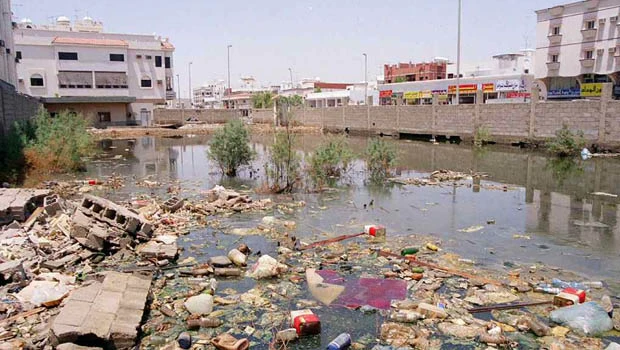
Five months after the agreement was signed, the Jeddah floods struck, killing nearly 130 people. Sewage lakes are now considered unacceptable. The city’s Musk Lake has been closed and is to be dried out.
Meanwhile, residents say they are fed up with the diseased and unsanitary environment they are forced to live in, blaming it on a hopelessly inadequate sewage system.
“It has been estimated that less than a quarter of raw sewage is treated, leaving residents to put up with cesspools that are continuously overflowing into the streets, causing disease and foul odors,” said Muna Al-Ahmed, a resident of Al-Rawdah district.
“Because of these problems, we are not allowed to walk outside and enjoy the environment because of sewage problems. The city has also been dumping sewage into the Red Sea, which causes contamination and prevents us from enjoying it as well.”
She added that pilgrims and visitors to the city wishing to see the sights could not do so because of disgusting smells, especially near the King Fahd Fountain and other attractions by the seaside.
Um Redwan, a resident of Al-Samer district near the now-closed Musk Lake, said she has plenty of room to walk and enjoy nature but has forbidden her children from going out in their neighborhood due to the air pollution and bad odors.
“My children beg me to let them go out to play but I am concerned for their health due to our location, which is not far from the sewage lake,” she said. She said that she continues to see people suffering from respiratory illnesses and skin and eye infections due to airborne bacteria from the sewage.
Arab News contacted the NWC more than one occasion this week for comments on the residents’ claims but there has been no response.