
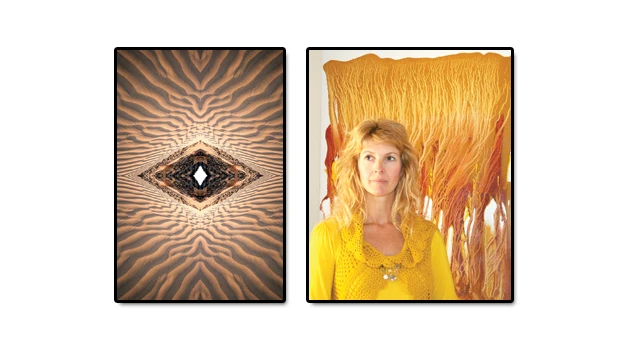
- Eli Acheson is a free-spirited woman expressing herself in the middle of the Saudi Arabian desert — through her paintings, that is.
A resident of Jeddah, for the past five years, the British artist gets her inspiration from the desert’s golden sand and sun. “I love the sand, it’s so raw,” says Acheson who holds a master’s in Fine Arts from Leeds Metropolitan University in the UK. She has exhibited her paintings and sculptures widely throughout the UK and Europe and even won the Royal Scottish Academy Award in sculpture.
It is in the vast desert that she feels free and unconstrained — her blond hair flows freely and visibly as she soaks up the sun’s rays. There are no people around, and her thoughts flow like the wind that blows through her hair and brushes the grains of sand against her cheeks. She spends some time there, observing the landscape and becomes fully aware of her surroundings…
“I’ve been so stunned by the desert’s landscape with its shades of yellow, orange, brown and gold partly because it’s so different from the greenery and color of where I’m from in the UK,” she says. “It also strikes me since my hair becomes blonder and my skin becomes golden-brown, making me relate to the landscape even more.”
That is what her first solo exhibition, “Sand to Soul Routes,” is all about. With the wind’s movement surrounding her, Acheson portrays in her paintings how the desert environment affected her soul so that her audience can feel that as well.
“My goal is to express the beauty and joy that I feel about this country, through my art, because there’s so much that is amazing and unique here,” she says.
Entering the Al-Alamia Gallery on its opening last Saturday, I was immediately struck by the warm colors of the paintings — shades of red, orange and yellow filled the room. With no sponsors supporting her, it is apparent that Acheson worked very hard in order to showcase her work and publicize the opening of her exhibition.
“I express the kind of freedom and independence I acquire from the desert through my art, which is also a celebration of color,” she says. “I absolutely adore color. So, my artwork is a positive statement celebrating this amazing world.”
The paintings she has on display are made from a liquid oil paint mixed with turpentine-type solvents and linseed oil. She chose to work with oil due to the nature of Saudi Arabia’s landscape. “The landscape is really best expressed in fluid art forms and not something solid, that’s why I didn’t create any sculpture art,” says Acheson.
Acheson does not use a brush to paint, but rather allows the oil to flow freely on its own through a procedure called “shifting” or moving the canvas. Before starting on a painting, she usually has a loose vision of something in mind, such as two areas merging and the effect that would create. However, she lets her artwork take its own form. Just like the wind that blows on the land and forms something, she tips the canvas to allow it to have its own development and take its own form. As a result, one shape takes on meaning in two or three different ways.
The paintings she has on display took 18 months in total to complete with each one taking between three weeks to two months. “They may take between three to eight weeks to paint as they are done in stages — or layers — and each layer may take between one day to two weeks to dry enough to work on successive layers,” she explains. In other words, if the painting contains many layers and a large amount of oil, it could take up to two months to dry.
She explains that each painting of hers is a track describing her journey of how the environment affected her soul. Her paintings are portrayed in shapes and colors, which represent the landscape and climate of the desert. “I work with the fluidity of paint and the movement of photography to exaggerate the colors coming from this landscape.”
“Oil Eye 3” is part of a series of similar photographs created from “pools” of oil paint. It is also the only painting she has on display that contains actual sand from the desert. The sand gives it a nice contrast since it absorbed the paint pigment and became a darker shade of brown. Acheson was trying to create an oil well to respond to the theme of oil that lies under the land of this region. She then realized that it looked like an eye image, which she felt had a relationship with the oil-producing countries.
“The pools of oil paint turned into eyes and I sought to suggest that eyes have focused on this oil-producing center. At the same time, the region looks back out at the world around it (through the eye) in a reflection of this regard,” she explains.
She also has a small corner with some photographic work, which are digital photomontages of desert dunes created from her own original photographs shot in the desert.
“I use a segment of these shots, photo edit and duplicate it in order to create images with a defined center. I also employ symmetry to obtain the effects that I want, playing on themes of eternity, which occur in several different cultural art forms, but used in a modern way here,” explains Acheson.
In her photograph, “Golden Sand Carpet,” Acheson used repeated abstract and linear forms in order to express spiritual feelings of the everlasting — just like the technique used in Celtic and Islamic traditions. Since she lives within both these cultures, Wales and Saudi Arabia, she wished to create artworks that expressed a similar connection and consciousness of these two different traditions.
Acheson’s work is not landscape painting in the traditional sense where you paint what you see, but more like a meditative process. “It’s about uncovering a landscape and being able to see the patterns of the land, like uncovering a human personality or spirit and being able to feel the communication of that creativity inside your soul,” she says.
Acheson celebrates the strength of womanhood and hopes that her work will encourage women to showcase their individuality. “I think that the act of making art is an affirmation of life because nobody tells you to do it, you just do. It is an act of independence,” she says.
Her painting, “Red Standing Woman Dune,” began as an intention to combine a further exploration of responses to the desert forms and a desire to express an abstract image of the strength of womanhood.
“Through the buildup of layers and desert-sourced red colors, it grew into a kind of tower — a giant dune shape — which came to represent my own feelings of strength in my gender identity and my passion for art and life,” she says.
with her work, visit her website at