
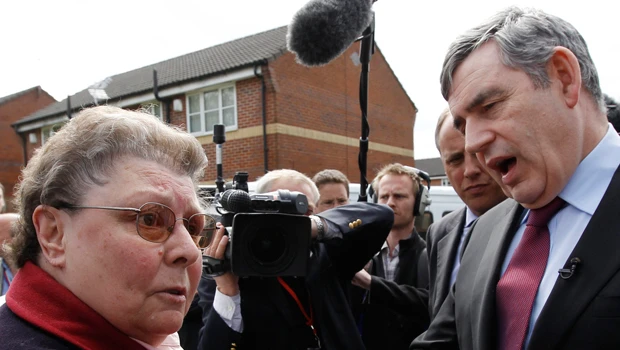
- LONDON: British Prime Minister Gordon Brown needs a show-stopping performance in a final election debate on Thursday to offset a blaze of bad publicity after he was caught calling a supporter of his Labour Party "bigoted.”
Brown has said Labour are in "the fight of our lives" to hold onto power after 13 years and Wednesday's disastrous gaffe will not have helped. The opposition Conservatives are first in all the opinion polls, with Labour and the smaller Liberal Democrats, or Lib Dems, vying for second place.
Brown, whose critics paint him as a socially unskilled bully, was recorded on Wednesday complaining about a woman in her 60s who had challenged his government's immigration policy.
"She's just sort of a bigoted woman," Brown was unwittingly recorded as saying to his aides after meeting Gillian Duffy. The comment has been replayed and analyzed countless times across the media.
He later apologised to Duffy in person, but his remorse may not appease many voters before the May 6 ballot, heaping pressure on him to claw back lost ground in Thursday's televised leaders' debate, the last of three before the election.
The US-style debates, a first in British politics, have dominated campaigning and the final debate at 1930 GMT will focus on the economy, the most important issue of the election as Britain struggles with sluggish growth and a huge deficit.
But Brown's gaffe dominated front pages on Thursday, as commentators agreed it would severely damage Labour's campaign.
"Day of disaster" was the headline of the right-leaning Daily Telegraph. "Brown 'penitent' after bigot gaffe torpedoes campaign," said the left-leaning Guardian.
A Labour minister said Brown would be "pulling out all the stops" in the debate.
"No one can suggest this wasn't damaging. I think you have to look at how Gordon responds," Home Secretary (interior minister) Alan Johnson told BBC radio.
British bookmakers sharply lengthened their odds against Labour securing a majority in the election, although some voters and pundits were more sympathetic, playing down Brown's outburst as a mistake anyone could make under pressure.
Lib Dem leader Nick Clegg's popularity surged after the first television debate, and opinion polls consistently predict the Lib Dems will grab enough votes to deny both the traditional main parties an overall majority, a result not seen since 1974.
The Conservatives, led by the telegenic David Cameron, say such a "hung parliament" would unnerve markets and damage the economy as parties jostled for position rather than tackling the deficit.
The media will scrutinise the last TV debate for any clues on the extent or timing of the budget cuts that will be required after the election to rein in a deficit running at more than 11 percent of GDP.
Politicians have been wary of scaring voters by being too candid about what are expected to be swingeing cuts.
The Conservatives want to present an emergency budget to cut spending, a move they say will safeguard Britain's AAA credit rating.
Both the Conservatives and Lib Dems warn that Britain risks a Greek-style economic meltdown if the deficit is not slashed.
Labour points to signs of economic growth, which it says will be put at risk if deep budget cuts are made too soon.
Such are the tough measures needed to tackle the deficit that winning the election could be a poisoned chalice, Bank of England Governor Mervyn King was quoted as saying on Wednesday.
US economist David Hale told Australian television that King had told him last week that "whoever wins this election will be out of power for a whole generation because of how tough the fiscal austerity will have to be.”