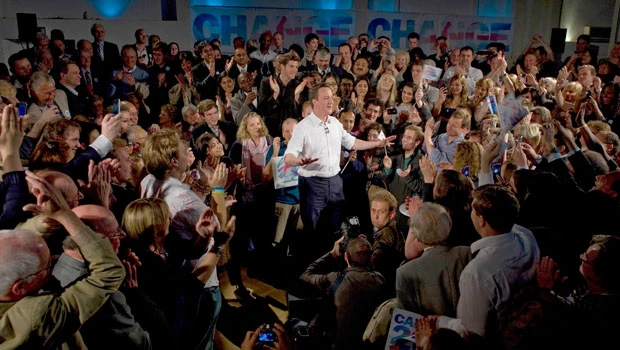
- LONDON: Energized by a clear win in a final TV debate, Conservative leader David Cameron sought on Friday to convince waverers in a tight election race they could trust him with Britain’s future.
With a week to go before an election, snap viewer polls judged Cameron, 43, the victor of the third and final TV debate on Thursday night. Liberal Democrat leader Nick Clegg, 43, was second while Labour Prime Minister Gordon Brown, 59, came last.
“This election is far from over. We are now entering the most energetic and the most important stage of this campaign... I’m taking nothing for granted,” Cameron said during an upbeat campaign stop at a school in Derby in central England.
His center-right Conservatives are battling to oust center-left Labour from power after 13 years, but their once-commanding opinion poll lead has shrunk in recent weeks. Most polls suggest the May 6 election will produce a “hung parliament,” one in which no party has an overall majority. That could deprive the Conservatives of a chance to govern alone, forcing them to seek Liberal Democrat support.
The TV debates, a novelty in Britain, raised the previously little-known Clegg’s profile and catapulted his centrist Liberal Democrats past Labour in many polls.
Surveys suggest that while many voters are fed up with Brown, they are not sure they can trust Cameron, a slick former public relations executive from an ultra privileged background.
With the wind in his sails after the debate, Cameron tried to build on that trust by launching a “contract with voters” that lists key Conservative policies on cleaning up politics, fostering economic growth and tackling social problems.
“This contract will set out our side of the bargain, what we’re going to do, and I urge people to read it, to hold us to it, to make sure we deliver it,” he said.
This was immediately dismissed by Labour as a “con trick.” But the Labour campaign was still struggling to overcome the fallout from a disastrous gaffe by Brown on Wednesday, when he was caught branding a Labour voter “bigoted.”
Labour drafted in Brown’s predecessor as prime minister, Tony Blair, who went out campaigning in London.
The charismatic Blair won a record three successive elections for Labour from 1997, but it was unsure whether many voters would be happy to see him again. He was unpopular when he stepped down in 2007, mostly because of the war in Iraq.
“Labour has got every chance of succeeding. But we will succeed best... if the focus is on policy,” Blair said.
Many in financial markets have expressed fears that a hung parliament could lead to political deadlock and delay tough calls on the deficit, which has ballooned in the economic downturn to about 11 percent of Gross Domestic Product.
“The market remains concerned about a hung parliament and with Cameron looking to have come first in the last TV debate, this offers a little bit of hope,” said Audrey Childe-Freeman, currency strategist at Brown Brothers Harriman.
Gilt futures rallied more than a quarter of a point in early trade on Friday, while sterling strengthened against the dollar.
While many in the markets favor the Conservatives, there has been concern about Cameron’s choice of the youthful George Osborne as the likely chancellor (finance minister) in his government. But Cameron strongly defended Osborne on Friday.
“George is an excellent shadow chancellor,” he said, using Osborne’s official title as chief opposition finance spokesman.
“I think he’d make a great Chancellor of the Exchequer. I think he has shown that steel and that judgment.”