
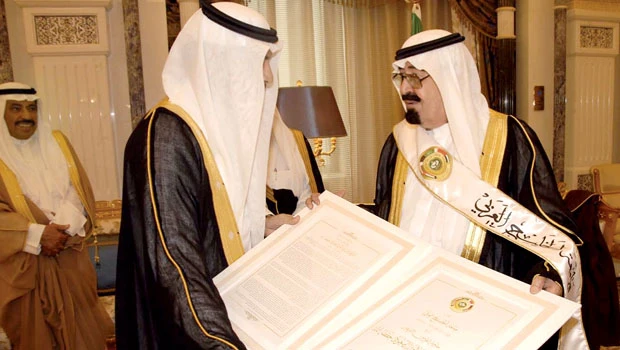
- JEDDAH: Custodian of the Two Holy Mosques King Abdullah received on Tuesday an honorary doctorate degree in the service of science and medical education from the Arabian Gulf University in Bahrain.
Dr. Khaled Al-Ouhali, the university’s president, awarded the degree to the king during a ceremony at Al-Yamamah Palace in Riyadh.
In a speech delivered at the ceremony, Dr. Muhammad Al-Bandary, chairman of the university’s board of trustees, thanked King Abdullah for supporting the university. Referring to King Abdullah’s SR1 billion donation to establish a medical city at the university during his visit to Bahrain last month, Al-Bandary said, "This donation reflects your keenness for charitable and humanitarian work.”
Al-Ouhali said the university’s board of trustees decided to award the degree considering King Abdullah’s huge, pioneering and strategic achievements and contributions at the regional, international and national levels.
The university head further commended the king’s statesmanship and farsighted vision as well as his capabilities to engineer consecutive achievements.
“He is the most popular leader in the Islamic world and one of the 10 most influential leaders in the world,” the president said, adding that the Saudi leader was named the champion of fighting poverty in 2008.
In its citation, the university described King Abdullah as a staunch supporter of the Palestinian issue, adding that he has been exerting consistent efforts to liberate Al-Aqsa Mosque from the clutches of Israeli forces. He proposed the Arab peace initiative in 2002 when he was crown prince. He also initiated the setting up of an Al-Quds uprising fund and an Al-Aqsa fund and has worked to strengthen Arab unity and solidarity.
At the international level, King Abdullah has tried to promote world peace and prosperity and called for interfaith and cultural dialogue. He also proposed the establishment of an international counterterrorism center and a general secretariat for an international energy forum.
The university also noted the king’s tremendous support of the GCC, the Gulf Monetary Union, the GCC power grid and the GCC railway. It also noted King Abdullah’s political, economic, social and administrative reforms, and his efforts to establish giant economic cities and improve the Kingdom’s investment climate. It further praised the king for taking the initiative to establish low-cost housing units for the poor in different parts of the country.
King Abdullah’s era also witnessed an educational renaissance in the Kingdom as the number of its universities rose from eight to 33 including nine private institutions of higher learning. King Abdullah’s foreign scholarship program has benefited more than 85,000 Saudi students. More than 60 percent of the country’s one million university students are women.