
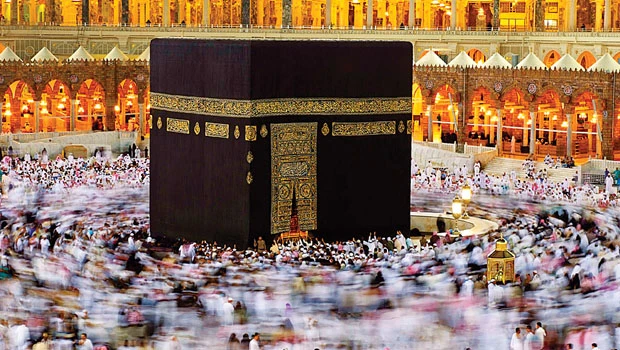
- Canon Middle East has announced that engineer and photographer Latif Al-Obaida’s shot titled “Holy Haram,” has been selected as the country winner for Saudi Arabia in “Celebrating My City,” Canon’s regional photography competition.
The grand prize winner in the competition was Sue Azmi, representing Kuwait with her photograph “Walking into Colors.” See the 13 national winning photos as well as the grand prize winner by clicking to: . The annual Canon photography competition encouraged photographers of all abilities to submit a city inspired image from across the region for a chance to win the EOS 500 D a DSLR Canon camera, or a Canon PIXMA Pro9500 Mark II professional photo printer.
“Canon Middle East is committed to supporting photography in the region and making it accessible to all. The quality of imagery submitted from Saudi Arabia was very high and demonstrated the entrants’ good photographic skills, with many entries managing to capture beautifully the essence of their unique city. The Canon competition has inspired the imagination and creativity of hundreds of passionate photographers from across the region, and enabled them to capture and showcase the best of their city using the power of image,” said Hendrik Verbrugghe, B2C Marketing Manager, Canon Middle East.
Verbrugghe mentioned that the quality of entries from across the region made the judging process difficult for the independent on-line panel of experts which consisted of well known photo editors and photographers. There were over 130 entries from Saudi Arabia alone. Commenting on Al-Obaida’s winning photograph, David Bell, a member of the judging panel said, “Loved the motion captured in this entry from Saudi Arabia. When you see such a wonderful image, you wonder how it could be shot any better.”
The photograph “Holy Haram” shows the tawaf, during which Muslims circumambulate the Ka’bah. Al-Obaida stated that the picture was shot four years ago during the Haj, using a slow shutter speed to produce motion blur. Certain elements of the photo, such as the architecture of the Haram, are static, while the pilgrims performing tawaf are dynamic, creating a blurred ring of motion. The shot was taken with a Fujifilm DSLR camera.
Photography is a hobby for Al-Obaida, and it is one that he is trying to encourage in the Kingdom. He is a board member of the Saudi Photography Association.
“Saudi Arabia is first in the Middle East in terms of the number of serious photographers and is the largest regional market for high end DSLR cameras,” Al-Obaida said. “More Saudi photographers are participating in international photo exhibitions than photographers from any other Middle East nation. Photography is booming in the Kingdom and it is becoming more than a simple hobby. Now there are Saudi photographers who are considering themselves to be artists. We are also seeing interest from young people in taking up photography as career.”
He explained that digital camera photography dramatically helped to overcome some of the Saudi social problems that were created when photos were taken with film. Digital photos don’t require developing by strangers and can be kept secure within a computer. As Internet use has spread in Saudi Arabia, it is now easier to share photos with friends and family wherever they might be. Al-Obaida added that the new trend of having better camera technology in mobile phones is also encouraging people to take photos all the time — not just for special occasions.
“Now everybody is a photographer, and that’s great. All the taboos have been broken. Prince Sultan bin Salman is a photographer and he pursued the change in the government’s position on public photography. Now, photography is allowed in all public places, except in those areas where there is a sign forbidding it, usually for security reasons. It is important though to recognize that individuals have rights and ask before photographing anyone — even in public,” said Al-Obaida. “These days, Saudis consider taking photos just a casual part of everyday living.”
Canon’s winner believes that it’s important to use photography to document life in Saudi Arabia — both on national and personal levels. He finds it disturbing though that there is still a lack of professional local training for photographers. While there are some short term photography courses in the Kingdom, no university or institute offers degree or diploma courses to develop talented amateurs into fulltime professional photographers. Al-Obaida thinks that this oversight is in urgent need of correction since 97 percent of those working in the Kingdom’s photography industry are expatriates and it’s a field that could offer good opportunities to Saudi youth.
Al-Obaida invites Arab News’ readers to view his images of Saudi life through . He is delighted that Canon’s judges, all non-Muslims, chose his photograph as representative of the Kingdom. “It’s a message,” he said, “that the feeling of tranquility found at the Holy Haram can be enjoyed by everyone.”