
- UNITED NATIONS: As the humanitarian crisis in Somalia deepens, the United Nations is taking steps to stop the diversion of badly needed aid to radical Islamist militants, according to a UN report released on Wednesday.
In March, a UN committee that monitors compliance with a UN sanctions regime imposed on Somalia and Eritrea submitted a report to the Security Council that said as much as half the food aid sent to Somalia is diverted to a network of corrupt contractors, Islamist militants and local UN staff.
That report urged UN Secretary-General Ban Ki-moon to open an independent investigation into World Food Program operations in Somalia and to create a database aimed at blacklisting people and firms linked to the kidnapping of aid workers.
In his latest report to the Security Council, Ban said the UN country team in Somalia has begun implementing a "risk management action plan" to address the problems highlighted in the Somalia monitoring group's March report.
He said a database has been designed that will include details on all UN service providers and contractors in Somalia so that they can be properly screened. He added that "due diligence" screening will be conducted as names are added to the database.
The report said there has also been a "revision of the internal controls over cash transfer systems within Somalia."
The monitoring group's report gave numerous examples of the problems facing aid organizations in the virtually lawless Horn of Africa state.
One example concerned a Somali businessman tied to al Shabaab rebels who likely received a ransom paid for kidnapped aid workers while working as a contractor for the World Food Program and the UN children's fund UNICEF.
Allegations of aid diversion had alarmed the United States, which cut back on support for the WFP in parts of Somalia controlled by al Shabaab, UN officials have said.
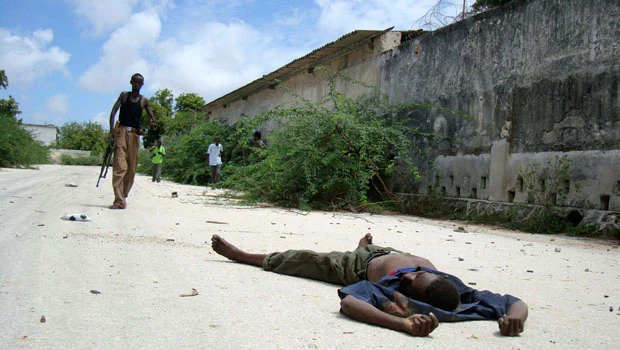
Ban's report also touched on what it said was a "widespread humanitarian crisis" in Somalia, where Islamist rebels have waged a three-year war against the fragile Western-backed transition government and now control large swaths of southern and central Somalia, and much of the capital Mogadishu.
It said 3.4 million Somalis - 43 percent of the population - need humanitarian assistance, including some 1.4 million within Somalia displaced by fighting. The country has been without an effective government since 1991. Aid agencies have had to cut back operations after al Shabaab threats.
UN special envoy to Somalia Ahmedou Ould-Abdallah told a meeting of the 15-nation council on Ban's report that the worsening humanitarian situation in Somalia was "horrendous." US and British envoys described it as "appalling."
Ban's report described some of the abuses in Somalia that violate international and humanitarian law in areas controlled by al Shabaab, which has been imposing its own harsh version of sharia law.
"Civilians in southern and central Somalia continue to be threatened and abused by armed group elements, stoning, amputations, floggings and other corporal punishments," he said.
Ban will be traveling to Istanbul next week for a May 22 conference on the Somalia crisis hosted by the United Nations and Turkey.
The United Nations has said that the international conference is intended to advance the peace process and its objectives of political stability, security and reconstruction. It will also focus on combating piracy off the Somali coast.
UN political affairs chief Lynn Pascoe told reporters he hoped the Istanbul conference will "send a strong signal" that Somalia has not been abandoned by the international community.
Ethiopia, meanwhile, said it expects another 25,000 refugees fleeing fighting in Somalia to cross its border by the end of the year and appealed for $13 million dollars to feed its refugee population.
UN food agency, WFP, which provides all food aid to refugees in Ethiopia, warned that without the extra funding it would have to reduce food rations by June this year.
"With the growing number of refugees, we call upon the donor community to support us to address this humanitarian crisis," Ayalew Aweke, of Ethiopian refugee agency, ARRA, said in a joint statement with UN refugee agency, UNHCR.
Ethiopia — one of the world's poorest countries — is home to more than 68,000 Somali refugees as well 42,000 from Eritrea and 24,000 from Sudan.
"The rapid influx of refugees from southern Somalia and Eritrea has put immense strains on the limited available food resources," WFP Ethiopia deputy director Lynne Miller said.
"Without additional resources, WFP will be obliged to start reducing food rations of refugees as of June 2010."
Somalia has not had a functioning central government since the 1991 overthrow of a dictator, since when it has been mired in violence and awash with weapons.
The Western-backed interim government controls just a few blocks of the capital Mogadishu, with much of the country carved up between the rebel militias of Al Shabaa and Hizbul Islam and pro-government group Ahlu Sunna Waljamaca.
Somalia already has 1.4 million internally displaced people, and another 575,000 have so far fled to neighbouring countries.