
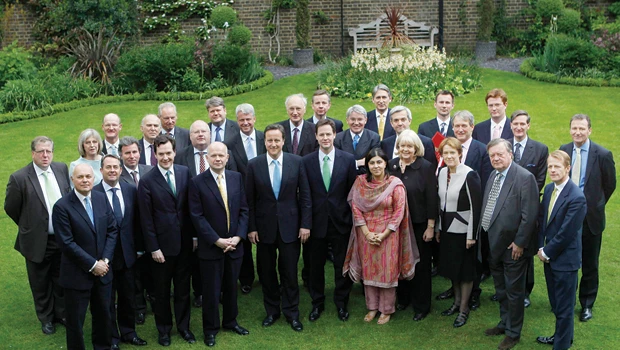
- LONDON: Britain's new coalition government cut its own pay by five percent on Thursday in a statement of intent about tackling a record budget deficit.
The center-right Conservatives and smaller centrist Liberal Democrats this week agreed on what critics call an unstable partnership of expedience after an inconclusive election.
Reducing Britain's record budget deficit of over 11 percent of national output will be the first test of the relationship.
A five percent pay cut for all ministers was agreed at the first meeting of the new cabinet on Thursday. Most senior ministers are paid more than 140,000 pounds ($206,800) - a generous salary in Britain.
Markets are looking for signs the Conservative-led coalition will quickly implement a plan to tackle the 163 billion pound ($243 billion) deficit by trimming public spending, initially by 6 billion pounds this financial year.
"We are all very aware of the seriousness of the situation and frankly if we don't have a credible program to reduce the deficit...then we won't have the confidence of the markets and the confidence of the country," Culture Secretary Jeremy Hunt told reporters after the hour-long meeting.
The government has promised an emergency budget within 50 days. Cameron said on Wednesday the government had the worst economic inheritance of modern times in Britain.
Economists quoted by British media said they also expected a rise in the VAT sales tax from the current 17.5 percent.
The head of British supermarket group J. Sainsbury said on Thursday that consumer spending would remain subdued and the focus should be on spending cuts rather than raising taxes to clean up finances.
"If the government does decide to increase VAT, they should give us good notice and they should be firm on the fact that that is going to stick for a very long time," King told BBC radio. "We don't want to see VAT swinging around in an uncertain and unpredictable way. It's very costly and complex for retailers to change VAT." Other legislation expected on the agenda soon is a plan for a banking levy, a commission to investigate separating retail and investment banking and plans to give the Bank of England more clout as a financial watchdog.
The atmospherics of the new partnership between Conservative leader Cameron and his deputy Liberal Democrat leader Nick Clegg dominated newspapers, with most focusing on their new friendship after weeks of sniping at each other on the campaign trail.
Commentators warned of trouble ahead given the two parties' traditional ideological differences and Britain's lack of experience with coalition rule. The new Parliament includes a large number of new members with little Westminster experience.
However, markets have so far reacted positively to the commitment to make an early start on spending cuts. Turmoil in the euro zone has also given British assets greater appeal.
Legislation will be introduced to give parliaments five-year fixed terms, but the lower house could still be dissolved if 55 percent or more of lawmakers vote in favor.
The coalition government ends 13 years of Labour party rule under Tony Blair and then Gordon Brown.
Key figures in the new government include finance minister George Osborne, Vince Cable, the new business secretary, William Hague, in charge of foreign affairs, Liam Fox with the defense brief and Theresa May, the new home secretary.
Osborne has become the youngest finance minister in over a century and some in the finance industry have expressed skepticism about his credentials.
Meanwhile, Britain's goods trade deficit with the rest of the world widened more than expected in March after imports grew more than five times faster than exports, official data showed on Thursday.
The Office for National Statistics said the data's volatility had been heightened by weather-related distortions at the start of the year, which shifted some exports into February, when the trade gap narrowed to a 3-1/2-year low.
The global goods trade gap widened to 7.522 billion pounds ($11.19 billion) in March from February's 6.305 billion pounds, after exports edged up by 1.0 percent but imports surged 5.2 percent, their fastest rate since September 2009.
The figures are unlikely to please Bank of England Gov. Mervyn King, who said on Wednesday that Britain's economy needed to refocus on exports and move away from growth based on domestic consumption.
Britain's goods trade gap with countries outside the European Union also widened more than expected in March to 4.103 billion pounds from 3.406 billion in February.
The total trade gap - which includes the harder-to-quantify trade in services - widened to 3.863 billion pounds from 2.187 billion pounds.
Britain's surplus in services fell to its lowest since July 2009 at 3.839 billion pounds in March, down from 4.118 billion.
Economists had forecast a global goods trade deficit of 6.41 billion pounds and a goods trade gap with non-EU countries of 3.35 billion pounds.