- TIANJIN: Chinese and Arab leaders agreed to develop China-Arab relations and discussed a number of regional issues of common interest at the China-Arab Cooperation Forum that concluded in Tianjin, China, on Friday.
As part of the “Declaration of Tianjin,” they pledged to establish relationships of strategic cooperation that would focus on comprehensive cooperation and joint development.
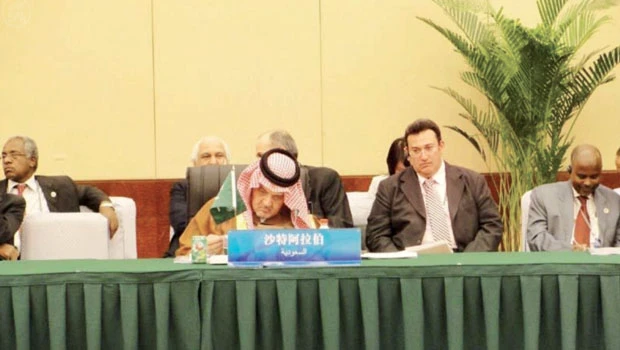
Foreign Minister Prince Saud Al-Faisal led Saudi Arabia’s delegation to the forum.
“The Chinese and Arab sides will achieve their goals through visits on various levels, talks and strategic consultations. They will continue mutual support in core issues related to common interests and boost their cooperation in areas of politics, economics, trade and environment, apart from coordination in international and regional matters,” the declaration said.
Chinese Premier Wen Jiabao on Thursday called for deeper cooperation between China and Arab states to create a peaceful international environment for development, fight the financial crisis, safeguard energy security and tackle climate change.
Wen warned of the present complications of the global financial crisis, with debts deepening in some nations. "We should never underestimate the seriousness and complications of the financial crisis and its deep impact on international politics and the economy," Wen said.
The global economy was slowly recovering, but its foundation was not solid, he said.
Wen also blamed the fragile recovery on high unemployment rates in major economies, high commodity prices and rising trade protectionism.
Wen said reforms of international economic and financial systems should be pushed forward and the establishment of a just and reasonable international economic and financial order should be accelerated.
"(We) should improve the decision-making processes and mechanisms at international financial institutions and boost cooperation in international financial supervision," he said.
While calling for opposition to all forms of protectionism and support for free trade, Wen said: "It is imperative to advance the Doha Round talks of the World Trade Organization toward achieving reasonable and balanced results as soon as possible." He urged major economies to transform the economic growth pattern of low savings and high consumption and to strengthen financial supervision to curb excessive speculation.
Wen said energy exporters and importers should step up dialogue and carry out cooperation in energy development. Investment in the energy sector should be encouraged to maintain a basic balance in energy supply and demand and reasonable global energy prices, he added.
The international community should work to maintain stability in energy producing countries and curb excessive speculation to maintain order in the international energy markets, he said.
On economic trade with Arab states, Wen said China was ready to stabilize trade in oil and natural gas with the 22 Arab League nations, while expanding imports of non-oil products.
"China at the same time will increase exports of high value-added machinery and electronic products and high-tech products to the Arab countries."
Trade between China and Arab states surged to $107.4 billion last year, from $36.4 billion in 2004.
China would continue to encourage businesses to invest in Arab states and welcome investment from Arab states, he said.
China was ready to promote cooperation in infrastructure, including power, railways and roads and to deepen cooperation in oil and gas projects, he added. Efforts should be made to vigorously develop energy-saving technologies and clean renewable energies to help tackle global climate change.
China has pledged to reduce carbon emissions per gross domestic product by 40 to 45 percent from 2005 levels by 2020.
Wen said China and Arab states should increase exchanges involving senior officials and consultations on strategic issues, as well as boost coordination in major international and regional affairs.
The forum was initiated in January 2004, when Chinese President Hu Jintao visited the Arab League headquarters in Cairo. It has since served as a platform for exchanging views between China and Arab nations and for enhancing mutually beneficial cooperation.