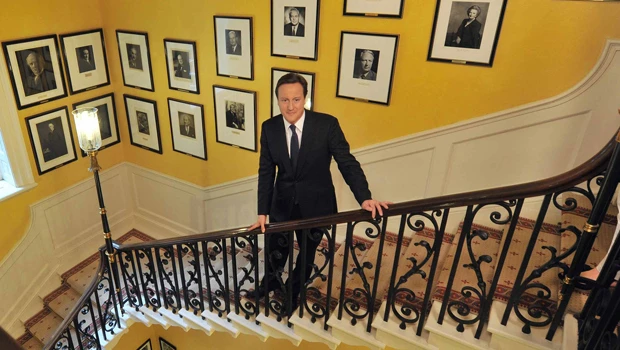
- LONDON: Britain’s new government will publish a fuller coalition agreement on a broad range of policies within two weeks, adding its actions will prove that the partnership works, Prime Minister David Cameron said on Sunday.
In an interview with BBC TV, Cameron also reiterated the government’s view that the brunt of action to tackle a record budget deficit of more than 11 percent of GDP should be spending cuts rather than tax rises.
Cameron’s center-right Conservatives joined forces with the smaller center-left Liberal Democrat party after the inconclusive May 6 parliamentary election to form Britain’s first coalition government since 1945.
The two parties set out an initial coalition agreement on Wednesday, covering decisions in key areas such as the economy, and subjects on which they have radically different views such as immigration, defense and Britain’s relations with Europe.
“We already have a very good coalition agreement ... we were able to look at the difficult areas of policy and agree those first, things like Europe and immigration and taxes, we have already done the heavy lifting,” Cameron told the BBC.
“We need a fuller coalition agreement covering other policy areas as well ... there will be a longer form document out in the next couple of weeks.”
Cameron’s coalition partner, Lib Dem leader and Deputy Prime Minister Nick Clegg, was preparing to face a special conference of party members where the agreement, which many activists feel involved the party abandoning its core values, will be debated.
While the vote on Sunday, which comes as two polls suggested some Lib Dem supporters had switched to the center-left Labour party, is unlikely to have an immediate impact on the coalition, a lack of endorsement from the wider party would embarrass Clegg and could raise questions about its longevity.
Former Lib Dem leader Charles Kennedy wrote in the Observer newspaper that he had not been able to bring himself to back the deal as he was concerned the party would lose touch with its fundamental values and be swallowed up by the Conservatives. But Cameron insisted the Lib Dems would play a central role in government and while he acknowledged both parties were likely to lose some supporters as a result of the partnership, he said the coalition’s actions would prove it was the right decision.
“If we can demonstrate that we are gripping the deficit, that we are succeeding in Afghanistan, that we are solving the country’s social problems ... if we can prove that then that is the best way of proving to either a disillusioned Conservative or a worried Liberal Democrat that it is a good thing,” he said.
Cameron said an independent audit of government spending would be launched on Monday and that spending, rather than tax, would bear the brunt of the burden in dealing with the deficit.
Asked about speculation the government was planning to raise the Value Added sales tax by 2.5 percentage points to 20 percent, he said “This is not something that we plan to do.” In a sign of his intention to rein in spending on public sector pay, Cameron said he would cut back the kind of bonuses paid to civil servants by the previous Labour government. “…we are going to severely restrict them, cut them by something like two-thirds,” he said. “Now that in itself doesn’t save a huge amount of money, that saves something like 15 million pounds ... from the large to the small, we are going to take action.”