- BANGKOK: Thai protesters defied warnings to leave central Bangkok as troops closed in on them on Monday, but officials said the army was not planning immediate action to disperse the thousands who say they will fight to the death.
An estimated 5,000 of the anti-government protesters hunkered down, listening to fiery political speeches and largely ignoring a 3 p.m. (0800 GMT) deadline to leave the encampment in a commercial district.
"We will keep sending warnings to protesters and will slowly step up pressure if they don't go," said Thawil Pliensee, secretary-general of the National Security Council, adding the military had no immediate plans to clear the main camp by force.
"Red shirt" leaders had proposed a ceasefire and talks moderated by the United Nations, which the government dismissed out of hand. On Monday, they said they would accept talks as long as a neutral arbiter took part and troops withdrew.
"The government is ready to go forward with negotiations when they end rioting," replied government spokesman Panitan Wattanayagorn.
A government source said talks were taking place behind the scene, but doubted any of the "red shirt" leaders had full control of the protesters, especially the more militant elements.
Around the city, people were hoarding food, while hotels were pleading for guests to leave. The new school term has been postponed and Monday and Tuesday were declared public holidays, although financial markets and banks remained open.
As fighting subsided in some areas, residents and tourists in the commercial district were seen leaving while they could, with luggage and children in tow. Chulalongkorn Hospital, adjacent to the encampment, had evacuated all of its patients.
Spradic clashes broke out in some parts of the city, but there were no reports of fresh casualties.
By Monday, the army had surrounded the encampment in an attempt to block people and supplies from coming and step up pressure on the protesters barricaded behind huge walls of tires, poles and concrete, topped by razor wire.
Military helicopters dropped leaflets on the camp calling on the protesters to leave immediately, and troops readied buses for any who wanted to leave, but no one was seen boarding them.
Fighting near the encampment was intense overnight. A rocket hit the 14th floor of the Dusit Thani Hotel, a Reuters photographer said, triggering gunfire from all sides in the pitch darkness, since power had been cut to the area.
Guests at the hotel were evacuated on Monday morning after spending much of the night cowering in the basement.
Fighting erupted in three areas of the city of 15 million people at the weekend as the army struggled to establish th perimeter around an encampment occupying 3 sq kms (1.2 sq miles) in an area packed with hotels, malls, offices and embassies.
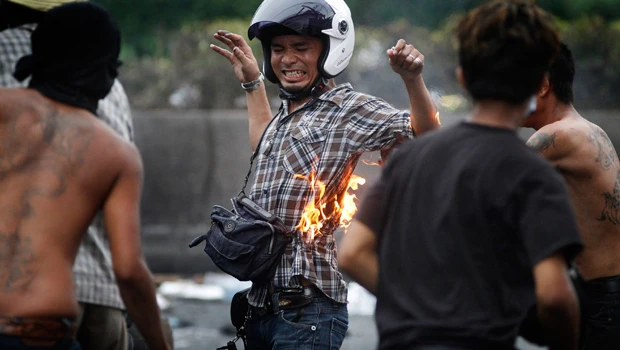
On Monday, protesters lobbed petrol petrol bombs and rocks, and rolled burning tires at troops, who returned fire in a run-down area near the business district.
An oil tanker was stolen from a petrol station, parked in the road and used as a defensive wall by demonstrators. Thailand's energy minister said it was mostly empty.
Those unable to get into the main encampment set up makeshift stages and barricades built with tires at three other locations in the capital, all major intersections in residential areas, where the military clashed with protesters.
"Our supporters in other areas will gather at these points if they cannot get into the main encampment," said Nattawut Saikua, a red shirt leader.
"We want negotiation, but we cannot do anything to control those outside if troops don't stop shooting," he said.
The death on Monday of a renegade major-general who was the red shirts' military adviser, and an embarrassment to the military, threatened to further stoke tensions..
Khattiya Sawasdipol, known as Seh Daeng (Commander Red), was shot in the head by a sniper on Thursday, fueling the latest bout of violence in a five-year crisis pitting rural and urban poor against an "establishment elite" that has traditionally run Thailand.
At least 37 people have been killed and 276 injured since then, according to Erawan Emergency Medical Center.
A protest leader, Jatuporn Prompan, told supporters in the encampment, including women and children: "The king's glorious mercy is the country's only hope now. It's the only way out."
King Bhumibol Adulyadej, 82, has stepped in to end past deadly crises during his 63 years on the throne, but has been in hospital for seven months and has not publicly commented on this latest turbulence.
Prime Minister Abhisit Vejjajiva vowed "no retreat" against "armed terrorists" seeking to topple his government.
The "red shirts", loyal to former premier Thaksin Shinawatra who was ousted in a 2006 coup, say Abhisit's army-backed government, which came to power 18 months ago in a controversial parliamentary vote, is illegitimate and want new elections.
At least 66 people have been killed and more than 1,600 wounded since the red shirts began their protest in mid-March.
A state of emergency has spread to more than a quarter of the country after emergency decrees were declared in five more provinces on Sunday, bringing the total to 22.
Protests -- small in number so far -- were reported in several provinces in the north, a Thaksin stronghold and home to just over half of Thailand's 67 million people.
Police in eastern Chonburi province said hundreds gathered overnight and were attempting to block a major port.