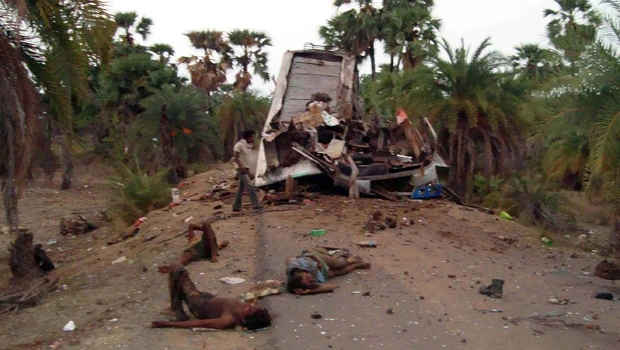
- NEW DELHI: Maoist rebels blew up a bus on Monday killing 50 people, 15 of them policemen.
- The attack, triggered by a powerful land mine, targeted the bus on the Dantewada-Sukma road in the central Indian state of Chhattisgarh.
This is the deadliest Maoist strike after an attack on April 6 killed 76 policemen in Dantewada. Chhattisgarh and the eastern state of Orissa have emerged as the flashpoints of Maoist violence in the past couple of months.
The Maoists regularly attack railway lines and factories, aiming to cripple economic activity. With the rebels controlling vast swaths of mineral-rich areas, the government has struggled at times to transport coal to power and steel companies.
Recent attacks on police have raised questions over how well prepared security forces are to tackle the Maoists, especially during a counteroffensive by security forces this year.
Indian Home Minister P. Chidambaram has said that he will approach Prime Minister Manmohan Singh for "air support" for anti-Maoist operations. He said chief ministers of all the Maoist-infested states had backed him on this.
India’s neighbor Sri Lanka used the military in its war on the separatist Liberation Tigers of Tamil Eelam (LTTE) and even bombed the LTTE-ruled areas. India, on the other hand, has so far used only police and paramilitary forces to fight the Maoists. Planes have been used only for airlifting troops and reconnaissance.
Chidambaram said that he had "a limited mandate" and insisted that there was a need to "revisit that mandate." The Cabinet Committee on Security had earlier rejected deploying either the armed forces or using air power against the Maoists.
The latest attack prompted a meeting between Singh and Chidambaram, who had offered to resign after the April 6 massacre.
Some strategists have favored a three-pronged plan to resolve the decades-long Maoist problem. This advocates fighting the Maoists, redressing the grievances that lead young people to embrace a violent ideology and initiating a dialogue.