
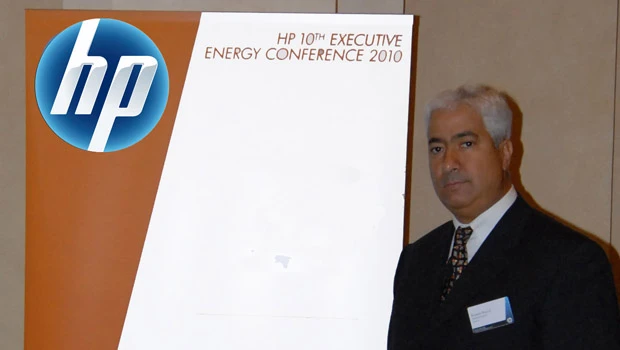
- DUBAI: Hewlett-Packard's 10th Executive Energy Conference in Dubai gave high-profile speakers, decision-makers along with oil-and-gas industry bigwigs a chance to discuss how the company is using innovation as a catalyst for business growth in the energy industry.
Members of HP's energy-industries wing provided an update on the company's recent and future activities during the three-day conference, which ends Wednesday. HP inventor Peter Hartwell presented the innovative CeNSE (Central Nervous System for the Earth) technology, which is at the heart of the company's recently announced seismic sensing solution.
Bassem Bouzid, vice president of HP's Energy Sector, Europe, Middle East and Africa, said the event brought together industry leaders from all over the world in a very attractive location. "The conference allowed participants to hear from an exciting panel of expert speakers about innovative solutions and market knowledge."
Bouzid said more oil-and-gas companies were participating in the event this year. "More than 56 percent of key energy firms are taking part in the conference."
He outlined his organization's impressive global reach.
"Today HP is the largest technology company in the world - committed to using our products and services to unleash new possibilities and have a meaningful impact on business and life," he said. "We are doing business in approximately 170 countries and have 304,000 employees, 145,000 sales partners, 210,000 service partners and 88,000 retail locations. HP has successfully integrated 30 companies in the past 42 months."
According to Bouzid, HP solutions are making life easier in ways we have probably never considered. "HP manages over 200 data centers, 380,000 servers, and 5.4 million desktops. We process nearly one billion US Medicaid claims a year. Our solutions stop 1.7 billion spam messages monthly. We process over 3.5 billion credit-card transactions annually. We book 500 million travel reservations every year."
He claimed that since 1968 HP has been the largest IT company in the Middle East with the widest market coverage.
"We have 12 subsidiaries in such countries as the UAE, Egypt, Algeria, Morocco, and Turkey and have seven sales offices in Saudi Arabia, Qatar, Oman, Lebanon, Libya and Uganda. We have two joint ventures in Bahrain, Kuwait and Abu Dhabi."
Peter Hartwell, the inventor at HP Labs, said the sensing technology is a key enabler of HP's vision for a new information ecosystem, the Central Nervous System for the Earth (CeNSE). Deploying many of these detectors as part of a complete sensor network would enable real-time data collection for a range of applications, such as bridge and infrastructure health monitoring, geophysical mapping, mine exploration and earthquake monitoring. This information can empower people to make better, faster decisions and take action to improve safety, security and sustainability of their employees, assets and companies as well as reduce their impact on environment.
"For example, dozens or hundreds of these sensors could be put on a bridge to show its performance under changing load or temperatures to detect a change in the structure before a catastrophic event. Likewise, embedding sensors in the Earth's surface could allow for more accurate identification and extraction of energy resources, reducing the impact of oil and gas exploration on the environment," he said.
The technology was selected as one of 20 "World Changing Ideas" in the December 2009 issue of Scientific American. Hartwell is lead of team developing a broad sensing system to bring environmental awareness to information technology infrastructure at HP Labs in Palo Alto, California.
Among the key speakers was Gabrielle Walker, who is described as "a frequent presenter for the BBC, who has climbed trees in the Amazon rainforest, hooked lava out of a live volcano, dodged icebergs and flown in zero gravity."
She described in detail how energy and power corporations can best prepare and respond to the implications of climate change and how to influence and work with government policy decision-makers.
Anil K. Gupta, one of the world's leading globalization strategists, shared his insight and expertise of the global energy market and how the increasing strength of China and India is impacting traditional energy producers.