
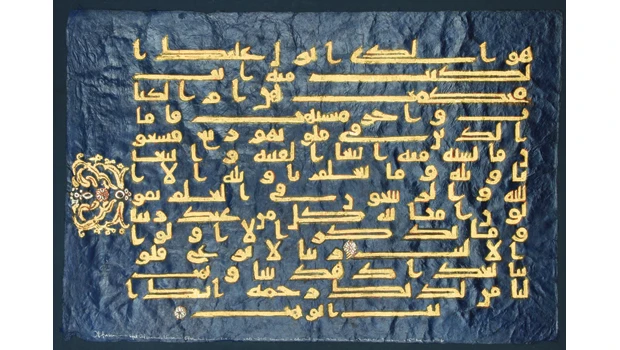
- Jeddah’s ATHR Gallery revealed its latest exhibition yesterday by London-based contemporary artist, Sheikh Tajammul Hussain.
- His collection, “Illuminating the World,” features a remarkable compilation of 33 pieces and attracted an intellectual audience to the gallery who praised both the scholastic achievement and artistic beauty of his works.
Sponsored by the Barakat Trust and Maharat Center, “Illuminating the Word,” opens today to the general public and continues until June 10. Proceeds from the exhibition will go to support the artist’s research and documentation on the art of illumination of the Holy Qur’an, the Barakat Trust and Maharat Center.
Hussain’s mentor was the late Dr. Martin Lings, the Keeper of the Oriental Manuscripts at the British Museum. It was under his influence that Hussain’s calligraphy began to take on the qualities of illumination through artistic portrayals of Qur’anic verses as a means to highlight the spiritual qualities behind the meaning of words. In addition to reclaiming the classic techniques of the old masters, Hussain utilizes traditional scripts such as Kufic, Thult and Muhaqqaq. His focus on geometric designs and color symbolism — a clear reference to his studies of Lings — elevates his work to a vantage point that transcends both ethnic and religious boundaries.
Hussain’s aim is to portray the verses of the Holy Qur’an through visual representation. His works are designed to highlight the sacred words of Islam with an emphasis on the interconnection between calligraphy and illumination through their juxtaposition. This fusion of the traditional and contemporary appeals to all generations.
Hussain’s overt attention to color and patterns is manipulated to reaffirm and illustrate the complexity and depth of the Qur’anic verses. The use of traditional calligraphy allows the familiar viewer to understand the text in full clarity, while the manipulation of the text into a pictorial composition allows the non-reader to appreciate it for its aesthetic qualities. Hussain advances the importance of color in his works from a decorative element to one that is on equal standing to its textual counterpart.
Each piece displays Hussain’s extensive knowledge of the history of Arabic script and its visual evolution. The artist’s hand is apparent in each work where imperfections are welcomed as evidence of the old master techniques. From the paper to the pigment, Hussain is present throughout the artistic process. Each component has an intentional purpose for its existence making the sum exponentially greater than its parts.
“It’s not merely decoration, but rather a language,” states Hussain, comparing the iconography within Qur’anic manuscripts to the ancient Egyptian hieroglyphics. “The text dictates what is to be included.”
This strict adherence has an academic backing that makes his works possess a dual function as both artistic ornamentation and documentation of a rarely disclosed history. Dissected into its various elements — color and iconography — Hussain’s pieces shine light on both the literal and figurative beauty of the sacred teachings of Islam.
Hussain is one of the only four living artists from the Islamic world to have been invited to exhibit at the Ashmolean Museum, University of Oxford, throughout its 500 years of history.
In addition to participating in numerous collective exhibitions in Muscat, Oman and London, Hussain has had a number of solo exhibitions in cities such as: Glasgow, London, Tunisia and Jeddah. Examples of his work can be found in the prestigious collections of the Ashmolean Museum, Glasgow Museum, the British Museum and the national libraries in both Lahore and Tunisia.
As a lecturer on the art of the Qur’an, he regularly gives talks at both the graduate and postgraduate levels of the at the Prince of Wales School of Traditional Arts, University of Oxford, School of Oriental and African Studies (SOAS), and through the British Council, at the National College of Arts in Lahore. Hussain has also given a number of public lectures to institutions all around the world including the UK and Middle East.