
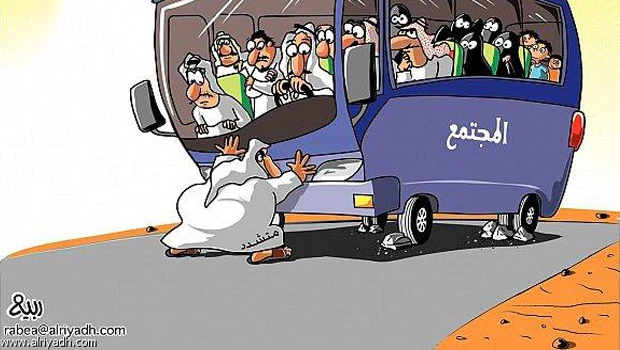
- JEDDAH: There has been an increase in the number of newspaper cartoons satirizing the Commission for the Promotion of Virtue and the Prevention of Vice (Haia) lately with at least four controversial ones appearing in one month.
The cartoons have attracted criticisms from Haia members as well as conservative members of society who say they portray a wrong and negative image, one that the agency has been working hard to dispel.
Turki Al-Sudairi, editor in chief of Al-Riyadh newspaper, one of the dailies that have been publishing caricatures about the Haia, defended his newspaper, saying that it is the newspaper’s editorial policy not to deliberately target the commission.
Al-Sudairi said Al-Riyadh considers the Haia to be a government body that cannot avoid public scrutiny. He said the commission's performance has improved following criticisms in the media.
He added that Al-Riyadh’s readers continue to be loyal because they know that the newspaper does not aim at maligning the commission but engages in constructive criticism by publishing both positive and negative opinions.
One cartoon that created furor recently was one by cartoonist Abdullah Al-Marzouk that was published in Al-Jazirah last Thursday. The cartoon showed a couple being manhandled by two Haia members and questioned whether they are related.
Al-Marzouk said he has received threatening text messages on his mobile phone and that his newspaper has received letters and faxes calling for him to be sacked. He added that he was inspired to draw the picture having read a story about a couple who were mistakenly accosted by members of the commission.
“I read the story before it went to print and then drew the cartoon. However, the cartoon went to print a day before the story, something that led to people getting angry. When the story was published the next day, people realized the context in which the cartoon had been drawn,” he said.
Al-Marzouk added that cartoonists face harsher criticism than reporters and feature writers, as cartoons can be more powerful. Despite the attack, Al-Marzouk still wants to continue publishing cartoons that constructively criticize the Haia. “I am not challenging the commission; it is like any other body and can be criticized for drawbacks,” he said. When Al-Marzouk’s cartoon was published in Al-Jazirah, the Haia sent a memo to the newspaper expressing its annoyance.
“The cartoon presents a distorted image that does not represent reality and conveys a negative message to society,” it said. “The commission is seeing much improvement and statistics show that it is supported by the public. We can add to this the fact that officials at the commission are dealing with negativities that may occur in a limited way.”
The memo continues by saying that publishing such cartoons does not help the commission in the work that it does in helping the public. It also called on Al-Jazirah’s editor in chief, Khaled Al-Malik, to assign reporters for the commission to engage with.
Cartoonist Khaled Al-Ghamdi, who was recently criticized along with his newspaper, Al-Watan, for publishing a cartoon of a conservative-looking man watching a couple sitting innocently by the beach with a thought bubble containing an image of the couple dancing coming from his head.
Al-Ghamdi said the cartoon depicts the mindset of people who distrust others. This distrust, he said, can only be justified in matters relating to security and not when it comes to people’s honor.
Al-Ghamdi, who has also been criticized by members of the public who support the commission, said he has not been advised by his newspaper to stop criticizing the commission.
He said the newspaper gives him the freedom to address issues and that he is not given direct instructions on what he can and cannot do. “The taboo lines are being brushed away,” he said.
Nevertheless, there continues to be an outcry over the cartoons — regardless of whether they appear in Al-Watan, Al-Riyadh or Al-Jazirah — as can be seen in the newspapers’ online comments sections and in Internet forums. Some people say the editorial cartoons depict reality while others say they are exaggerated.