
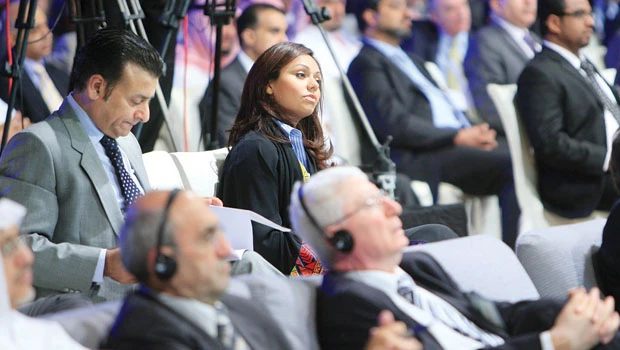
- Al-Seraisry calls for private sector’s role in transport projects
RIYADH: Jabara Al-Seraisry, minister of transport, has urged the private sector to take a major part in infrastructure projects in the Kingdom.
While addressing the two-day Euromoney 2010 conference, which concluded on Wednesday, Al-Seraisry said since the establishment of Saudi Arabia, infrastructure had been receiving support and attention and was placed among the government’s top priorities.
“This is the result of the deep awareness that no development can be made without infrastructure, and no sustainable economic growth can be achieved without enabling factors based on a network of roads, railways, telecommunications, airports, seaports, schools, universities, hospitals and water and electricity,” he said.
Al-Seraisry said except for the years in which the major component of government revenue — oil — witnessed a considerable decrease, the state budgets are truly development-oriented. The costs of new projects and the new additions to previously approved projects amount to SR260 billion in the budget of the current year with an increase of 16 percent compared with the budget of 2009 where the costs of projects were the highest.
Al-Seraisry admitted that hard transport projects such as roads, seaports and railways had modest attraction for private investments, even before the financial crisis struck the world two years ago. He said the private sector of course sought to have a reasonable and fast return. “When it enters into long-term investments, it requires government guarantees, which sometime may be inconsistent with government financial policies. This doesn’t mean that private investments are not involved in transport projects. However, such projects are limited when compared to the total number of projects executed by governments. They are subject to liquidity availability and financing terms.”
Al-Seraisry said the recent crisis increased the reluctance of private investors to be involved in infrastructure and led to prioritizing private investments. Lack of liquidity, high cost of finance, state of uncertainty, and contradicted indications of global economic growth placed low return investments, especially those which need a long time to get back their capital, at the bottom of the private sector’s investment plans.
He added the very wise policies of Custodian of the Two Holy Mosques King Abdullah in all fields, at the micro and macro and structural levels have augmented the financial and economic stability enjoyed by the Kingdom for many years, and placed it in the forefront of countries whose policies have international confidence and are attracting investment.
The World Bank report on investment climate 2010 shows that the Kingdom ranks 13 among 183 countries and is a case in point. “It will not be surprising therefore, to see the private sector increase its desire to finance infrastructure in Saudi Arabia including some transport projects,” Al-Seraisry said.
Talking about the role of the private sector in employing Saudis, Omar M.S. Al-Jaroudi, chief executive officer of SHUAA Capital, said the private sector was slow despite government support. "The private sector has to grow. It has to diversify outside oil. It has to take more initiatives to employ and train Saudis," he said.
Al-Jaroudi said the government's spending on various projects is a positive move and it will help the economy grow further." Mohammed Al-Kharashi, governor of the Public Pension Fund (PPF), in his address, focused on the essential role for PPF in Saudi economic development and pensioners service. "We can not carry out our mission without creating mega-investments, especially real estate investments such as KAFD (The King Abdullah Financial District), Tech City and other future projects," he said.
Investment in KAFD is in harmony with our policy since PPF is investing in order to fulfill existing and future liabilities, he said, adding KAFD was one of the main financial hubs in the world since it has been established within one of the largest economies in MENA (Middle East and North Africa).
Since PPF's establishment, more than SR282 billion was paid to more than 1.2 million pensioners and beneficiaries by the end of 2009, he said.
"We are looking for brighter future for our country, society and citizens," Al-Kharashi said.
"We are looking forward with hope to our next mega-Obhor project. The Obhor project will create 1,500 residential units and shopping centers, which fulfill 10 percent of market needs by 2020 and create sustainable development in Jeddah,"he added. Commenting on the success of the Euromoney conference, Brad Bourland, chief economist at Jadwa Investment, said: "This is the premier sector conference in Saudi Arabia each year and, in its fifth year, it has brought together the key financial sector leaders."