
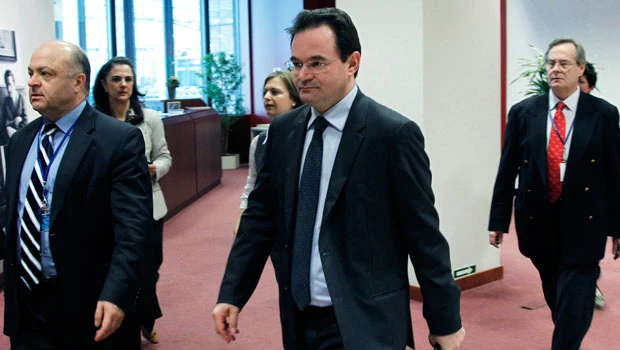
- BRUSSELS: European Union finance ministers broadly supported calls for new and tougher sanctions against countries that break EU budget rule on Friday, in a move to shore up the euro and guard against a debt meltdown.
The ministers were meeting at an inaugural gathering to discuss changes to the way the 27-nation bloc manages public finances and coordinate economic policy, as investors drop the euro, pushing the common currency down 6 percent this month.
"We discussed sanctions and I can say that ... there is a broad consensus on the business of having financial sanctions and non-financial sanctions," European Union President Herman van Rompuy, who chaired the talks, told a news conference.
"Everyone was ready ... if we need, to go ahead with new sanctions that are not provided for in the Stability and Growth Pact," he said, referring to the EU's budget rules.
The ministers' discussions, which will continue until October, were based on last week's proposals from the executive European Commission and ideas from Germany which wants to go further than the EU executive arm.
Both sets of proposals call for swifter and broader sanctions for countries that repeatedly break the EU's deficit limit of 3 percent of GDP.
Both also call for mechanisms to make countries bring their debt levels below the EU ceiling of 60 percent of GDP.
EU governments are trying to regain investors' confidence after months of turmoil that have pushed many euro zone member states' borrowing costs sky high, led to a 110 billion-euro bailout of Greece and the setting up a $1 trillion safety net to try to prevent the contagion spreading.
The debt crisis has provoked huge instability in the 11-year-old euro currency, shared by 16 countries, and led to demands for EU states to work much harder on coordinating their economic policies and bring their finances into check.
"This is only the start of the process... But there was a strong political will among the European Union finance ministers to move forwards on the EU's budget rules," Van Rompuy said.
One of the proposals of Germany, where public opinion has been angered by emergency loans to Greece which for years broke EU budget rules and manipulated statistics to hide it, was to create a mechanism for an orderly sovereign default.
But Van Rompuy stressed such a mechanism was only a long-term option, not something that would be considered as part of the 3-year Greek emergency package or the 3-year euro-zone 750-billion-euro safety-net for other euro zone states.
"It is only in a long-term context that one member country considered that if a permanent crisis resolution framework were to be developed in the future for the euro area, consideration should be given to a procedure for orderly state insolvencies," he said. "In the short-term, nobody proposed that kind of scheme."
EU finance ministers, or their representatives, will meet twice more before June 17 and prepare a progress report for EU a summit of leaders. The conclusions of the talks will be presented for an EU summit in October.
Germany has said that the challenge of reforming EU budget rules was such that no option should be excluded, even ones that involve change to the EU's basic structure - the EU treaty.
But given the long and cumbersome process of renegotiating a treaty, finance ministers agreed on Friday to first focus on solutions that would be easier to implement.
"(In the future) we will discuss even issues which may require an amendment of the (EU) treaties," German Finance Minister Wolfgang Schaeuble said after the talks.
"First, though, we will do what we can do without treaty changes and then examine the options," he said.
Britain's new prime minister and Germany's chancellor agreed Friday that a stable euro is in the interest of all Europeans - even nonmembers - but disagreed on how much regulation the markets can stand.
David Cameron made his first visit to Berlin to meet with Angela Merkel a day after he held talks in Paris with French President Nicolas Sarkozy. Both Cameron and Merkel described their talks as friendly and underlined the importance of cooperation in combating Europe's economic crisis.
Yet Cameron made it clear his government has very differing views over some of Merkel's favorite causes, including increased regulation of financial markets and products.
Asked to comment on Germany's decision Tuesday to ban naked short-selling of euro bonds that spooked markets, Cameron said: "Obviously we should respect each other's decisions on these issues," but indicated he saw the issue more as a symptom than a problem.
"It seems to me that the cause of many of our problems in the European economies is excessive debt, excessive deficits, financial systems that haven't worked, banking systems that have ground our economies down," Cameron said.
Merkel defended the move as important to Germany as an effort to prod Brussels into passing more strict European-wide guidelines.
"We have noticed that regarding naked short selling and credit default swapping, regulatory efforts have speeded up a bit but are not to our satisfaction yet," she said.
Cameron also stressed that Britain would not support an EU treaty to help bail out the euro zone.
"There is no question of agreeing to a treaty that transfers power from Westminster to Brussels," Cameron said.
Merkel insisted that a treaty was only one of several ideas on the table.
"There are ideas from Germany where treaty changes would play a role, but we say very clearly that we're just starting this work," the chancellor said.