
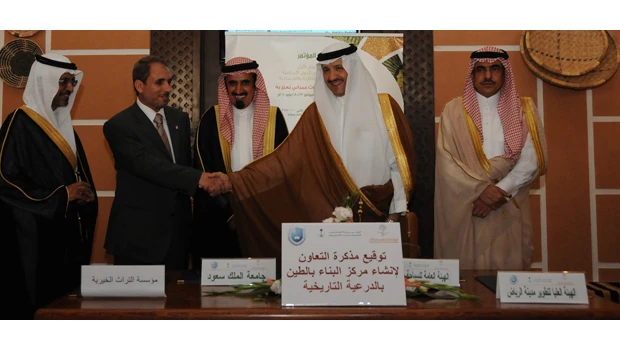
- RIYADH: The Saudi Commission for Tourism & Antiquities (SCTA) signed an agreement on Sunday to establish a center that will research innovative ways of constructing and restoring buildings using clay.
The SCTA will be working with the Higher Commission for the Development of Arriyadh, King Saud University and the Al-Turath establishment. The center will be established in the Darriyah area. The agreement was signed on the sidelines of the First International Conference for Urban Heritage in Islamic Countries.
The center will aim to encourage the use of clay and its derivatives as a primary material for construction, restoration and maintaining urban heritage.
"The project is an example of the Kingdom's leading and historical role to rehabilitate and maintain urban heritage and buildings," said SCTA Chairman Prince Sultan bin Salman upon signing the agreement.
He added that clay was a relatively unused natural resource mainly found in the Kingdom's deserts. Though people have formed the notion that clay buildings crumble easily, statistics from Germany reveal that over one million structures made with clay have been standing tall for hundreds of years.
The clay building has a longer life than the cement building, claimed Prince Sultan.
Meanwhile, the BBC presenter Zeinab Badawi praised the Kingdom for taking a step in promoting its cultural heritage and that “all countries with urban heritage face the same challenges.” Badawi made the comments on the sidelines of the event.
“We are looking forward to it playing a key role in the wider world about promoting cultural heritage,” said Badawi, adding that she believes that the Kingdom, like other countries, faces huge challenges in trying to engage public opinion and the wider public in preserving and conserving its cultural heritage.
“There is a real need to go back to basics, as it will be a shame if it was just a project that involves the international elites that work for governmental organizations or elites within countries themselves,” said Badawi, adding that it is essential to try and involve the wider community and the only way to do so is by integrating cultural heritage into people’s daily lives.
The BBC anchor , who is doing a television discussion program on the value of cultural heritage not only in the Muslim world but all over the world, said that cultural heritage is a way to generate jobs, show people how to learn from their past, and help a country find its national identity.
There are 36 speakers scheduled to speak at the conference on subjects such as the existing situation of urban heritage in the Islamic world, models of preserving cultural heritage, the financial dimensions of urban heritage, successful projects in investing in urban heritage, government efforts and private sector initiatives in urban heritage, research on the matter, teaching and training in urban heritage, and environmental changes and their impact on urban heritage.