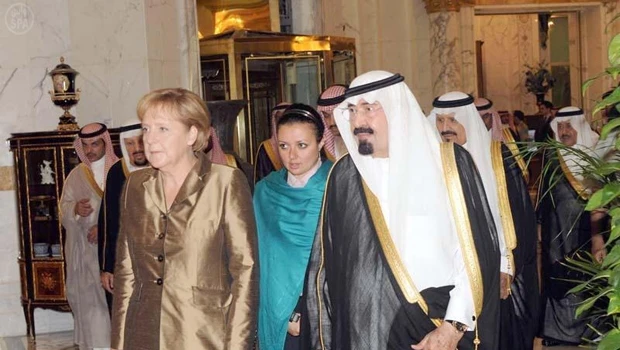
- JEDDAH: German Chancellor Angela Merkel arrived here Tuesday for talks with Custodian of the Two Holy Mosques King Abdullah and other top Saudi officials on expanding economic, commercial and political ties.
She was received by the king at his palace late Tuesday and her discussions with the king and Crown Prince Sultan, deputy premier and minister of defense and aviation, focused on ways of reviving the Middle East peace process, boosting regional security and the nuclear standoff with Iran.
Her talks in Saudi Arabia, which is a G20 member, were also to cover planned reform of the financial markets and the upcoming G20 summit in Canada. Merkel's foreign policy adviser Christoph Heusgen said GCC countries have a central role to play in resolving the standoff with Iran.
Speaking to reporters in Abu Dhabi before leaving for Jeddah, the chancellor pledged to boost trade across the Gulf region. German cars and consumer goods have a major presence in the Gulf, but efforts to further expand economic ties were underscored by the high-level business delegation accompanying Merkel.
She said GCC leaders have "a very good understanding" of the need to control deficits under a shared currency. She noted, however, that the region's oil and gas wealth allow it to "invest in the future."
Merkel tried to keep the focus on bolstering economic links with the region — repeatedly noting Germany's interest in expanding the estimated 60 billion euros ($74 billion) in two-way trade between Germany and the entire Middle East. "While political ties and initiatives are important, it ultimately comes down to creating investment opportunities," she said.
The German leader visited King Abdullah University of Science and Technology, an international research university located north of Jeddah. Accompanied by a delegation of German business leaders, Merkel will hold talks Wednesday with Saudi businessmen and women at the Jeddah Chamber of Commerce and Industry on expanding bilateral trade and joint investment projects.
Saudi Arabia is Germany's third largest trading partner in the Middle East. Saudi Finance Minister Ibrahim Al-Assaf announced recently the Kingdom's plan to carry out infrastructure projects worth 300 billion euros during the next four years and many German companies would be interested in them.
Merkel sealed contracts for plastic production and a natural gas service during her first stopover in Abu Dhabi in the United Arab Emirates. The UAE is one of the most important economic partners for Germany in the Middle East. She will also visit Bahrain and Qatar before returning to Berlin.